On the internet, I rarely engage in social/political/religious discussions. That’s not for a lack of opinion. On the contrary, I am constantly reading up on various issues plaguing the world. Recently, there has been an unprecedented upsurge in social and political developments, developments that have reverberated around the globe, affecting most of us via the ripple effect of globalization. Naturally, people want to discuss and deliberate over the nuances of what is going on. So far, so good. The trouble is, the nuances of the nuances are privy to only a handful.
From the British referendum that led to Brexit to the Orlando shooting, from the horrid Nice attack to Salman Khan’s insensitive rape equals physical exhaustion analogy and to Kim Kardashian stripping down to all her natural and not-so-natural glory for the nth time, there are issues and incidents that are routinely featured via social media to people across the globe. Herein lies my first bone of contention. There is clearly a hierarchy of importance of these issues. However, social media doesn’t always project it in that manner. It is quite baffling to see that sometimes the coverage given to a terror attack update is similar to that of a celebrity sharing a childhood photo or some PR strategy employed for the promotion of an upcoming film. In the subsequent outcome, many stories that need exposure end up losing out because they become one amongst the myriad news items in the sea of online news.
The tendency of knee-jerk reactions on online platforms is staggering. The moment an update is put up for the world to see, people barely take minutes, sometimes mere seconds to give their take on the respective issue. These instantaneous reactions are seldom based on an analytical assessment of the incident and tend to rely on inherent bias. The Rohtak girls’ incident comes to mind. People were scathing and relentless in their criticisms of the alleged miscreants. Many reputed portals highlighted the story, building up a lobby of opinions that were close to permanently damaging the reputations of those wrongly accused. And when the truth came out, only a handful owned up to their mistake and made a public apology.
People don’t realize that in today’s day and age, every word they put up on Facebook or Twitter has weight. Day in and day out, people’s words have the power to make or break someone. No one understands it better than the people Jon Ronson has mentioned in his acclaimed book So You’ve Been Publicly Shamed. Ronson, a Welsh Journalist talked to several people who had been victims of online shaming. The case of Justine Sacco in particular is horrifying to read. In what was supposed to be a sarcastic, satirical jab at the bubble white people believe they live in, disassociated from problems and diseases they consider belonging to third world countries, Justine tweeted out this right before she boarded a flight-
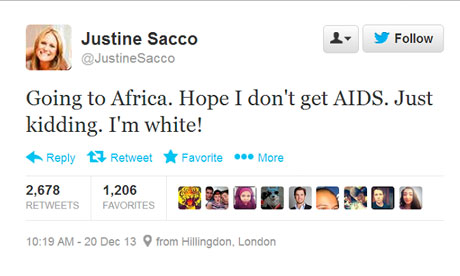
Justine Sacco Tweet
This single tweet turned her life upside down. In the subsequent flight, during which Justine’s phone was off, her tweet was shared virally, and within minutes she was a globally trending topic. Without even bothering for a clarification from her side, people went ballistic online. Before Justine landed, there was an online movement to get her fired off her PR job and a countdown was initiated for her landing, when Justine herself was oblivious to these developments. The aftermath wasn’t pleasing. Not only was Justine fired, she was mocked and shamed globally, and till date struggles to get jobs and to go on dates. Justine tried her best to defend the context of her tweet but it was too late. Those who were central to her shaming, however, swiftly moved on to the next item on their timeline.
This brings me to the next problem. Attention spans. People have surprisingly limited attention spans these days. I am quite convinced some of you who clicked to read this article might have even abandoned it halfway, uninterested in investing even 5-10 minutes on this article. This is the era of instant gratification. Therefore everything has a shelf life, even news items. Citing a recent incident, Kashmir was afflicted by a development involving army officials and protestors. In the wake of that, conflicting views were shared publicly. What surprised me was the rampant ignorance spread in the comments section. People were commenting left, right and center, and nothing was relevant or helpful in resolving the crisis. The opinions shared reeked of bias and ignorance. The debate was initiated, yet it never reached its conclusion, for all the loose ends remained untied, and the world swiftly moved on to the tragic massacre in Nice, France. Nobody undertook the responsibility to familiarize themselves and others with facts, and those who did, were buried under piles of comments that bubbled up due to ‘likes’ by equally prejudiced and ignorant people. These days, if you do decide to take up the debate through a logical discourse by educating yourself first, a process which would naturally take some time, you are considered to be out of step with the trend, for you have missed the ‘window of opportunity’ pertaining to the issue. Its almost as if taking time to put forward a measured, weighted and logical stance is an undesired quality.
All of this doesn’t imply that one should lose faith in the idea of voicing opinions online. Social media is integral in formulating public opinion and is an active stakeholder in reflecting societal expectations and perceptions. But public opinion isn’t shaped by haphazard discussions. They are shaped by quality discussions that impart value and provide a path to solving crisis. I don’t discourage people from being outspoken, but if they could just add an element of accuracy and legitimacy to the claims they make online, backed by facts and sources, it is much more likely to spark off a discussion in the right direction. You always run a risk of being heckled by trolls. And trolls, much like salacious gossips, are aplenty and always looking for an opportunity. But that comes with the territory I suppose. Conflicting viewpoints aren’t dangerous. Unsubstantiated viewpoints are dangerous. So for those of you reading this, who got infuriated with something I wrote and are furiously punching the keys on their keyboard in a moment of passionate fury, just pause for a moment, collect your thoughts and facts, assess your argument and then press Enter and set forth a civilized debate.


One comment