Reflecting upon the last few weeks of my epeolatry adventures, I’ve sensed a profoundly universal theme running through the books. Sadness. If asked to define sadness, most of us would spring to the definition of happiness so that we may create contrasts. Would that suffice though? Emphatically not. For in the books that I read, sadness itself was a continuum. In A Little Life, it was unflinching, dark, and encompassing. In The Casual Vacancy, it was an unpleasant presence. In The Bell Jar, it was a looming shadow, following Esther everywhere. In I Know Why the Caged Bird Sings, it was deeply entwined with hope. And in The Color Purple, it was slowly receding, giving way to a long-pending and deserving joy for Celie.
A Little Life by Hanya Yanagihara is a deeply disturbing take on the bleakness of life. The main character Jude St. Francis, is a successful lawyer who has had more than his share of tragedy and misfortunes in his life. That he is irreparably traumatized due to this, is no surprise. But what is truly saddening about his story, is his struggle to feel loved when there are people around him who care for him more than he can ever imagine. His friends, his mentors, his professors are so fond of him yet he feels guilty for feeling loved, that he doesn’t deserve it. More than love and life and family, it is a story of unquestioning friendship, something that Jude realizes himself and even advises to a socially isolated child he mentors.
“You won’t understand what I mean now, but someday you will: the only trick of friendship, I think, is to find people who are better than you are—not smarter, not cooler, but kinder, and more generous, and more forgiving—and then to appreciate them for what they can teach you, and to try to listen to them when they tell you something about yourself, no matter how bad—or good—it might be, and to trust them, which is the hardest thing of all. But the best, as well.”
In contrast to this notion of friends and companions pulling you through the upheavals of life, The Casual Vacancy presents a suffocating version of a middle class environment, where familiarity breeds contempt. Spouses hold grudges, children resent parents, neighbours despise each other. It is a vicious cycle of sadness, frustration, and despair. One that, unfortunately, but understandably ends in tragedy. While in A Little Life, people understand each other more than they give themselves credit for, in Casual Vacancy, they don’t get each other at all.
The Bell Jar, forever entwined with the tragic life of its author, Sylvia Plath, is a tale of a woman’s descent into depression. The sadness isn’t a theme here, it is more of the canvas, the base of the story that is ever present, even in the happier moments. The protagonist, Esther Greenwald, a talented writer from a privileged background undergoes a debilitating mental breakdown and is institutionalized. And all the plans she had had for her life, she sees them fall in front of her eyes, in an analogy that was captured in this quote –
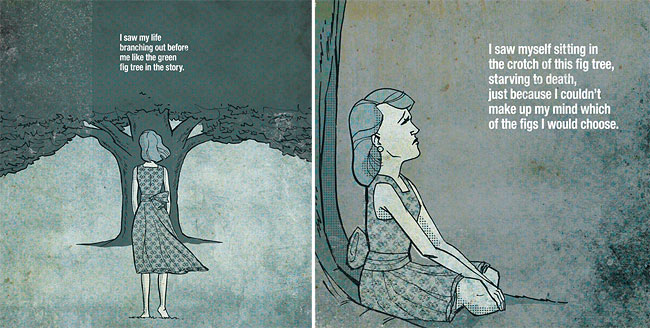
Credits : DigitalDurda
“I saw my life branching out before me like the green fig tree in the story. From the tip of every branch, like a fat purple fig, a wonderful future beckoned and winked. One fig was a husband and a happy home and children, and another fig was a famous poet and another fig was a brilliant professor, and another fig was Ee Gee, the amazing editor, and another fig was Europe and Africa and South America, and another fig was Constantin and Socrates and Attila and a pack of other lovers with queer names and offbeat professions, and another fig was an Olympic lady crew champion, and beyond and above these figs were many more figs I couldn’t quite make out. I saw myself sitting in the crotch of this fig tree, starving to death, just because I couldn’t make up my mind which of the figs I would choose. I wanted each and every one of them, but choosing one meant losing all the rest, and, as I sat there, unable to decide, the figs began to wrinkle and go black, and, one by one, they plopped to the ground at my feet.”
Maya Angelou, ever so profound, ever so wise, shared the story of her childhood in I Know Why…, whose title is derived from a poem she wrote. She describes growing up in a religious household with her disciplinarian grandmother, after being left in her care by her parents. She talks of a gnawing sense of neglect upon being abandoned by her parents. She unflinchingly talks about being sexually abused by a stepfather, and how a family friend had helped her see her true worth. She shares the stories of the camaraderie she enjoyed with her older brother. Yet, it is hard not to feel the tinge of sadness in her anecdotes. It’s a wistful sadness, accumulated over a span of time. Sadness, nonetheless.
The Color Purple, one of my personal favourites, is the story of an indomitable spirit. Celie has been through every misfortune a person can dread facing in his/her life. Raped and impregnated by the man she called father, sold off to her eventual husband, physically beaten and tortured, she feels so ashamed of herself that she writes letters to God, thinking that she won’t be able to verbalize her hardships in front of other people. Yet, she perseveres and finds true contentment in the end.
What shall I make of these varying degrees of sadness? How shall they reflect upon me as a reader? Does it say something about this genre that I have chosen books written by women only? Does it say something about me?
I wrote about these stories systematically. Going down the order, the amount of hope and redemption in the stories is more and more. Perhaps it’s an example of my eternal optimism. Or a desire to subconsciously avoid dealing with an ever permeating sadness. The fact that they were all stories by women is something that I picked upon only while writing. I would love your insights into the same. Please do share them in the comments.
Someone I know once told me that they avoided reading gritty and sad material for it disrupted their cheery disposition. I worry if that is akin to burying one’s head in the sand. One of my favourite movies, Inside Out, impresses upon the need to actively feel sadness. It’s an emotion that one mustn’t deny themselves of. For all our love for the days gone by, isn’t nostalgia a sense of bittersweet sadness? In a philosophical sense, isn’t the idea of seeking happiness itself linked to sadness? We’re always encouraged to push past our sadness. To look away from it. Is that why we are living in a world where people are increasingly unhappy? Because we’re forced to maintain a façade? While I won’t encourage anyone to wallow in sadness, I do think, and a lot of articles on emotional health concur, that it is important to atleast acknowledge your sadness. Turning the other cheek would only set you up for a harder fall. Don’t actively look for situations where you may feel sad, but if you do feel so, accept it.

Credits : Disney Wiki
As usual, I will leave more questions unanswered than I shall answer. For it is not my place to tell you what to think, but before you deny yourselves the opportunity to feel your sadness, do keep in mind this touching monologue that I read in the final episode of a marvellous comic series, ‘The Kids are All Right.’
I open my eyes and am in a white place. In this place, I see a huge gate, a tree, and an angel.
“Take this paper. And write the most painful memory you have from your life.
Now take a walk around the tree. The papers hanging from the tree contain the sadness of the others who have passed through here.
Now I’ll give you a chance to choose a better life. Choose one of the stories from the tree. And it will be your next life.
You’ve chosen to relive your previous life of pain. Are you sure you won’t regret it?”


WOW beautiful deep thought provoking piece.
LikeLiked by 1 person
Thank you so much. I’m glad you liked it.
LikeLike
My wife said she lived the color purple herself. I am trying to get her to write a “color Purple” book herself. What I thought about this blog was my blog on the opposite of addiction. Similarly, the opposite of sadness is not happiness, but being in (functional) community, for one can be lonely, isolated and sad in a dysfunctional community.
LikeLike
You point out something very valid. Any form of art that is cathartic, must be brought to the public. I would love to read what your wife may end up writing. I would love to read your thoughts on the mentioned article on addiction. Take care.
LikeLike