An article exploring Kepler, the person – sci-fi novelist, dedicated son, and astute scientist.
Do you remember Johannes Kepler? For those of you who had Physics in Class XI, this scientific bad boy made a cameo in the chapter on Gravitation, mentioned a page after the one which carried his three laws of planetary motion. Do you remember the laws? (Hint : Law of Orbits, Law of Areas, Law of Periods). Do you know anything else about his life? If you know next to nothing, don’t fret. I didn’t know squat either. Truth be told, I didn’t even remember the laws. But I read about him in Maria Popova’s Figuring, and she gave this visionary a backstory, a personality, a rich, vivid life, enough to make me wonder why my textbook didn’t carry any vestige of the same, and how many fascinating people and events never made it to those pages; forever hidden behind the sole accomplishment that was ascribed to their identity. So here’s an attempt to deconstruct the earthly man behind the planetary laws.
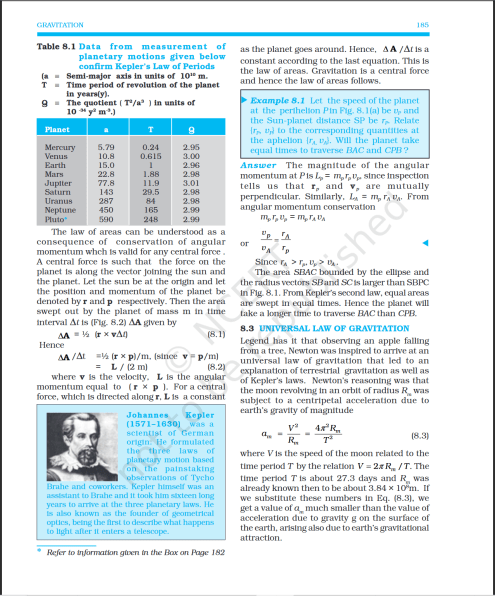
Sadly, this was all the space that Kepler was given. Credits: ncert.nic.in
The year is 1617. It is wintertime and Kepler is rushing to reach home. His mother, Katharina, has been put on trial for witchcraft. If he doesn’t make it in time, she will likely be executed. Katharina, known for her mercurial temper and frequent arguments with the villagers has been accused by twenty-four locals there.
“- One neighbour claimed that her daughter’s arm had grown numb after Katharina brushed against it in the street; the butcher’s wife swore that pain pierced her husband’s thigh when Katharina walked by; the limping schoolmaster dated the onset of his disability to a night ten years earlier when he had taken a sip from a tin cup at Katharina’s house while reading her one of Kepler’s letters. She was accused of appearing magically through closed doors, of having caused the deaths of infants and animals.” – Figuring
These accusations come on the heels of the locals having heard distorted retellings of The Dream, passed as gossip. The Dream is a novel that Kepler has written, perhaps the first recorded instance of the scientific fiction genre. It’s a story of a young astronomer who travels to the Moon, only to realize that the people living there believe that the Earth revolves around them. What was cleverly posed in that novel was the suggestion that perhaps our confidence in Earth being the centre of the universe was not scientific truth but a mistake of our vantage point. Today, this notion may seem like just the creative inquisition of an interesting man. But the 1600s were a different time, kind neither to science, nor scientists.
These were days when the Roman Inquisition was declaring the claim of Earth’s motion heretical – punishable by death. Thousands were being executed for claims of witchcraft. In The Dream, Kepler had mixed facts of his life with fiction of his mind. The protagonist shared details from his own life like being a mentee of Tycho Brahe. The protagonist’s mother, in the story, was described as a herb doctor who conjures spirits to help her son voyage to the Moon. Katharina, in real life, was a herb doctor. The villagers took the claims of The Dream as fact and thus what happened, happened.
It is under these circumstances that Kepler did his work. Brahe had died, leaving behind volumes of astronomical data, Kepler’s children had died of smallpox, there was not enough money to obtain legal counsel for Katharina. Kepler undertook that himself too. For six years, he documented evidence against 49 accusations labelled against his mother, using reason to refute every single one of them. It didn’t work. Katharina was sent to jail. He fought hard to get her out but it only happened after a year. Katharina soon passed away.
A friend of Kepler’s soon got a decree from the Duke to ban witchcraft trials. Kepler went back to his manuscript of The Dream, and annotated every mention with its scientific footnote, the end product becoming the size of the novel itself, after 223 footnotes. Determined to get the book published himself, he worked on the typesetting, sold off bonds in Austria, borrowed money, and stayed with an acquaintance to get the job done. It wasn’t meant to be. He died shortly. The grave where he was buried was destroyed by a religious war in the next few years.
I used to think of scientists and mathematicians as dull, dry, academic, sharp, but isolated people. Reading that small blue paragraph, I had no reason to doubt my ridiculous judgment. Not anymore. I don’t hold it against my textbook for according him a tiny corner in the chapter that he made possible in the first place. I hold it against myself that I didn’t try to do anything beyond it. Now I know that Kepler was a lot more than his laws.
This was a man who achieved greatness not during his time but despite it.
PS. I am planning to make this a series of articles about people/things/events that were part of our syllabi in school but left out some really interesting stuff about them. If you have recommendations, please share them in the Comments below.
Credits : Figuring, Maria Popova


Can you try one for Pierre Curie? I’ve always thought of him as unjustly over-shadowed.
Also, about the The Road Not Taken? All those deep interpretations of our English teachers aside, I’ve read in bits and parts that it Frost had quite divergent thoughts when he was actually writing it.
LikeLiked by 1 person
Thank you for the suggestions. I will look up Pierre Curie’s story.
Yes, by most accounts, ‘The Road Not Taken’ is a poem about regret and not happiness at having chosen a path. But most people take it to be an inspirational poem.
LikeLike
http://ckraju.net/papers/Calculus-story-abstract.html
Kepler and most western scholars dod have their inspirations or simply pligarised Indian texts.
Perhaps, you can also mention this.
LikeLike
Thank you for sharing this. I will go through it.
LikeLike