In my constant quest to discover new pages and reading material to follow online, I stumbled across the page of Akshay Dalvi. Akshay maintains a page on Facebook called ‘Words of Akshay’ which deals with micro-fiction. With over 96000 people following the page, I was certainly intrigued. I approached Akshay for his opinion on micro-fiction. He was kind enough to respond. Reflecting on his success, Akshay shared,”I tried writing micro-fiction 2-3 years back but I did not get the attention I wanted. Nevertheless, I carried on with my blogs, poetry and short stories. Upon my father’s passing, I started expressing my emotions via short stories. I started getting positive reactions. Within 3 months, my page went from 3000 followers to 96000+ followers.”
Akshay isn’t the only one to have capitalized on the success of micro-fiction. Terribly Tiny Tales and The Scribbled Stories are some other Indian pages that immediately come to mind. Micro-fiction isn’t as micro as it is made out to be. It actually involves literary pieces up to 1000 words. However in my article, I shall focus on micro-fiction as it is popularly observed today in social media. Interestingly enough, micro-fiction isn’t quite the literary innovation of technology that it’s made out to be. The idea of conveying a certain amount of depth in limited words might sound revolutionary in a day and age where attention spans are abysmal and memes have officially taken over as the gold standard in humour, but micro-fiction goes far back in time. Historical precedents have been observed in Japan, China and Latin America. One contemporary Japanese micro-fiction is Ketai fiction which consists of stories long enough to fit into a single text. It is popularly dubbed as ‘mobile phone fiction’ and is directly responsible for the rise of Twitter Lit i.e. stories designed for single tweets.
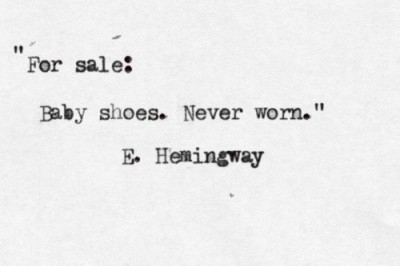
Hemingway’s 6 word story : Arguably the most popular example of micro-fiction. Credits : thedestinymanifest.com
It has, however, experienced an immense boom in recent years. As social media truly established a foothold in the social and web sphere, people were quick to capitalize on the attention they were able to garner easily. Although sustaining people’s attention turned out to be quite a challenge. Estimates by Hackernoon show people spend upwards of 4 hours on their smartphones daily yet attention spans have fallen to an astounding low of 8 seconds. Therefore, the idea of providing people with a ‘story’ that can be read in one go, using a fairly limited vocabulary, and with scope to be interpreted in multiple ways seemed as though it was tailor-made for the current times. And like most trends these days, it came like a wrecking ball. As it picked up traction, writers soon began experimenting with visual and audio media to incorporate into their work and to expand their outreach. It divided readers into pro and anti factions very soon.
The proponents of Twitter Lit stand for the level of emotion that those few words are able to evoke in them. Many feel that it is rather convenient to stick with reading 10 different ‘stories’ in a single day rather than following 1 over 10 days. It makes for an easy travel companion and one can ingest, process and forget multiple stories within hours. For the writers, it promises an ease of access to a dedicated reading audience, a far reduced maze of bureaucracy to navigate while sharing their work and convenient marketing of their talents. It offers an accessible platform to many budding writers(is there a separate term for micro-fiction writers?) who can dip a toe into the pond of the writing business before diving entirely. It makes for an easy assessment of their abilities based on the reactions they are able to generate. Micro-fiction has successfully been able to establish itself as a focal point of expression when it comes to social issues. The 2014 Peshawar Massacre stands out as one prominent incident. Micro-fiction pages have picked up on various issues like inter-caste marriages, untouchability, female infanticide, female literacy, LGBT rights to name a few.
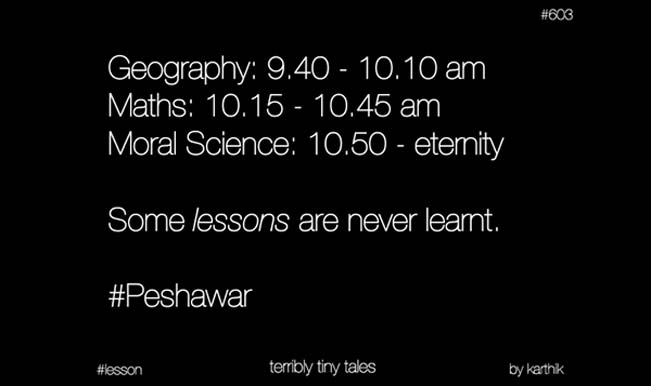
One of the many tweets on the Peshawar attack. Credits : Terribly Tiny Tales
On the other hand, most literary purists felt that the brevity came at the cost of quality. Literature, and acclaimed literature at that, has always been associated with verbose, articulate expression, with vivid metaphors and myriad figures of speech. To reduce those into mere words was not something the purists could get on board with. Ardent readers also felt it was difficult to truly admire the work since most of the micro-fiction left it upon readers to find an emotional connect with the work. Many readers would support me when I say that while reading books, the authors make it incredibly easy to bond with the characters since you familiarize yourself with a significant amount of detail pertaining to the characters. You go through their lives, their ups and downs and are able to form an attachment to the character. Micro-fiction forces you to look for instances from your life or from the lives of those around you for you to create a situation where you can see that piece of writing fitting in so that you may process its essence. It lacks the depth in character, plot and setting. Therefore it runs a risk of being extremely hit and miss with the audience. Moreover, the barometer to establish good and bad micro-fiction is fairly non-existent. It is so easy to pass sub-standard and mediocre work as micro-fiction. And it finds a dedicated audience easily which aggravates the problem.
It’s difficult to make a case against its popularity. The daily traction these pages generate is validation for their approval by the masses. What needs to be questioned though is if, like various trends,it has already peaked. One sure shot way of establishing a trend’s peak is identifying when it starts being lampooned. And already, various parody pages have cropped up which not only mock the work of these pages but have also found comparable success vis-à-vis crowd attention. Whether it’s a case of ‘Imitation being the best form of flattery’ is something that only content creators can answer, but it does suggest a shift of tone in the quality of micro-fiction that the audience now expects. While the pieces dealing with serious social issues remain fairly untouched by parody pages, the sappy, emotional posts dealing with love and heartbreak find themselves caricatured and ridiculed the most. In the coming months, the position of parody pages will offer an interesting insight into the entire trend. Will they overpower the pages they mock? Or will they wither out in favour of something else?
This brings me to another question. Given its current adoration/notoriety among the masses, should micro-fiction be treated at par with ‘regular’ literature? Although there are various competitions that acknowledge and reward flash fiction like the Bath Flash Fiction contest and the Ernest Hemingway Flash fiction prize (I have shared the links of more flash fiction contests under References [3] for your benefit) but true mainstream literary acknowledgment has eluded Twit Lit. I don’t necessarily see Pulitzer or Man Booker establishing a separate category to accommodate Flash Fiction. If they do change their mind, should they merge them with the existing categories or should they create a standalone version? If this doesn’t work out, should a separate entity take it upon themselves to honour Twit Lit? Or should the idea of bringing monetary encouragement be discouraged and should people be left to enjoy it for what it is? Feel free to share your opinions on the same in the comments section.
Mainstream literary acknowledgement aside, content creators still churn out content on a daily basis. Is this a profitable profession? Should we be taking it more seriously? Akshay shares, “If you are a digital marketing personnel, you can make it profitable. But you require a high traction and being just a writer won’t suffice. You would need business acumen to integrate brands. It’s a difficult task. The idea is to give both the stakeholders an equal opportunity – brands to express themselves and viewers to enjoy what is written.” It does raise a question of authenticity when you bring in a stakeholder beyond yourself but I suppose that is a question asked of anyone involved in business. Striking the balance between authenticity and success from a business point of view is something most artists and writers handle day in and day out. But those who wish to venture into this as a standalone profession with no experience should definitely reconsider their position.
It will be difficult to divorce technology from literature as years go on. While paperbacks still enjoy a dedicated readership, online literature is soon coming into its own. Whether micro-fiction will be able to stand the test of viewership is up for debate. Will it succumb and merge with another pre-existing form of literature? Will it form an unusual alliance with another trend that is yet to emerge? Will the takeover of memes finally render literature obsolete? Micro-fiction is micro only in its name. Bringing together writers, businessmen, readers and various societal reflections under its purview, it has captured the zeitgeist of reading, if not literature in the digital age. And to deny it of this achievement would be selling it short.
What do you feel about micro-fiction? How much has it radicalized your reading experience? Do you see it surviving the test of time? Do share your opinions in the comments.
References :
[1] http://www.writersdock.com/2011/10/16/a-short-history-of-microfiction/
[3] http://thejohnfox.com/2016/03/flash-fiction-contest/
Note
You can follow Akshay’s Facebook page, Words Of Akshay here.
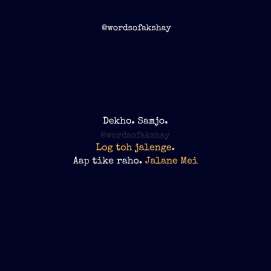
One of Akshay’s most viewed pieces


That’s such a nice take on micro-fiction and meme outburst in our time. It’s so true that people just don’t have enough time to follow literature like they used to. I know because i am guilty of that crime.
LikeLiked by 1 person
Thanks Niranjan! We are all guilty of not giving literature the time it perhaps requires of us. But it is never too late to start making amends 🙂
LikeLike
Great piece!
I think the lack of story or character depth plays an important part in the success of micro fiction. As human beings, we are always in search of something or someone we can relate to. This fundamental need to connect is like an addiction. The loopholes in the context of micro fiction thus becomes an advantage. We unconsciously think of instances to relate to it. And the more people we see like/comment on such a post, we more intrigued and drawn we are to engage in it. Voilà, your micro fiction piece just became viral!
LikeLiked by 1 person
I think you nailed the formula behind micro-fiction’s success. It has carved a niche for itself in the market today. Let’s hope it delivers on the quality side of things as well.
LikeLike
What an awesome analysis of micro fiction. I’ve been thinking about this for a while and I agree a lot with what you said, but I think it’s more than just brevity that has appeal. As udittyagi94 said, part of it is projection. But I also think there’s something about one or two lines that can hit you in the gut. The Hemmingway example is a great one just because it isn’t just what’s there or what we project…it’s whats not. My approach to writing dialogue and my experience is sometimes the shortest lines cut the deepest. Before we even get to full on projecting, and after we put the meaning together there is this space where we just react. The minimalism in the Hemmingway example is what sends it over the moon. Micro fiction works best when you have this potent sort of punch and a fair bit of self-restraint.
LikeLiked by 1 person
You’ve put it really well. Sometimes, less is more. It’s about the power you pack in those few words. However, that in itself, is an art. And everyone cannot manage to do that. That ability to exercise self-restraint, as you put it, is something inherent to a handful and/or takes years of dedicated work to achieve. Nonetheless, micro-fiction is certainly the trend of our time and one can onlhy speculate how it may develop further.
LikeLike