An article reviewing the titular book by the famed blogger and writer, Ms. Popova
“Lives interweave with other lives, and out of the tapestry arise hints at answers to questions that raze to the bone of life: What are the building blocks of character, of contentment, of lasting achievement? How does a person come into self-possession and sovereignty of mind against the tide of convention and unreasoning collectivism? Does genius suffice for happiness, does distinction, does love?”
How do I even begin to summarize Figuring? When I finished reading it, I sat in silence and thought about all the people who were part of the book. I am writing this after taking nearly half a day just to collect my thoughts and feelings. Figuring talks of people whom I had seen mainly as a product of their intellect, their identity restricted to their achievements, and others, of whom I had no idea. Figuring traces the stories of a handful of people- a cast of artists, writers and scientists – mostly women, mostly queer, as Maria herself writes on the back cover. It starts off with Johannes Kepler, famed for the discovery of the planetary motion, and weaves its way to the 20th century to Rachel Carson, catalyst behind the environment movement. In between, we read about Maria Mitchell, an astronomer, Margaret Fuller, a journalist and critic, Harriet Hosmer, a sculptor, and Emily Dickinson, prominent poet.
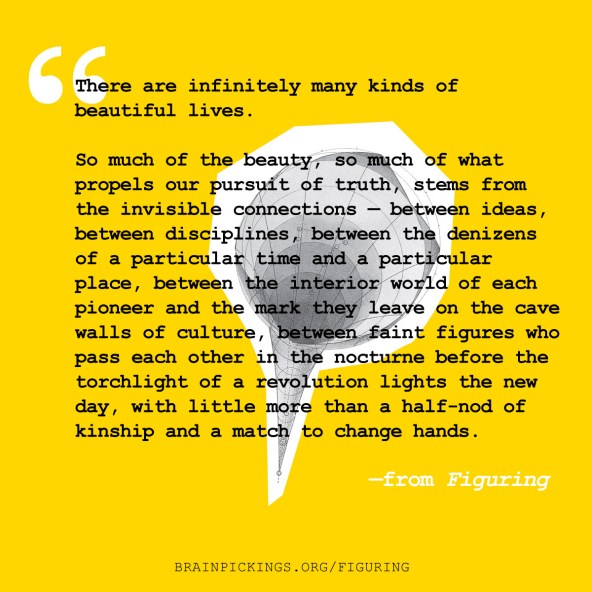
Of the entire spectrum of humanity that has lived, why only these people? I suppose only Maria can answer that. But what happens in between the stories of these people, as written in the book, is a work of literature that blends science, art, and life in a seamless combination, often impossible, and more importantly futile, to tell apart. As a child, I remember reading about some of these people. Kepler, in particular had been allotted a rectangular box in my Physics textbook. The miniature biography that accompanied his picture was dry and forgettable. I too, did not care to venture further, and made do with his laws, and found it convenient to look past the person behind them.
Quite often, notable people are presented to us as one-dimensional tropes – eccentric, genius, passionate to the point of having no life, devoid of social inclinations. What Maria Popova has done so beautifully is to tie the person to their accomplishments but also let these accomplishments be a fragment of who they were. Kepler in my mind is no longer just a scientific prodigy. He is now a person who was struggling to bring his work to fruition against the backdrop of the Church’s disavowal, a creative visionary who wrote possibly one of the first science fiction books called The Dream, and a son fighting a legal battle to save his mother from execution for being accused of witchcraft by vindictive neighbours.
Similarly, Rachel Carson has been demystified as a lot more than the woman behind Silent Spring. She is the embodiment of lower-middle class perseverance, a woman who spent her life refusing to adhere to the notion that science and literature were segregated fields. Rachel is also the woman who fell in love with her neighbour Dorothy, Rachel is a woman who even in the final stages of terminal cancer, made sure she answered the letters of students who wrote to her. A woman, who like most women, could not escape the patronizing gaze of men, who when challenged by her intellect, dismissed her as a ‘hysterical spinster’.
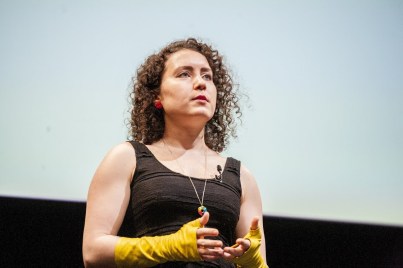
Maria Popova : Courtesy – Wikipedia
The book has helped open my eyes to the fact that the world owes so much to women and queer people. So many visionaries who lived their lives with a tragic irony – fighting against conventions to produce something to enlighten those who discredit them. What remains of them are handfuls of documents, forever shrouded in mystery. Maria herself writes that,
“Beyond any human lifetime, and often even within it, what is recorded is what is remembered, the records gradually displacing the actuality of lived events. And what is recorded is a fraction of what is thought, felt, acted out, lived- a fraction at best edited by the very act of its selection, at worst warped by rationalization or fictionalized by a deliberate retelling of reality.”
It’s clear to see that this book is a labour of love. Just to conceptualize this would have taken so much effort, I can’t even fathom what it took to bring this to fruition. But I’m so glad Maria did it. I have never read anything like this before. A compliment that was directed to Rachel Carson must also be used for Maria – “Books like yours are not written to order; they grow on the writer”. Before my review devolves into incoherence, I must pause here. I leave you with a paragraph from the book, equally vivid in its imagery and humbling in its interpretation.
“Meanwhile, someplace in the world, somebody is making love and another a poem. Elsewhere in the universe, a star manyfold the mass of our third-rate sun is living out its final moments in a wild spin before collapsing into a black hole, its exhale bending spacetime itself into a well of nothingness that can swallow every atom that ever touched us and every datum we ever produced, every poem and statue and symphony we’ve ever known—an entropic spectacle insentient to questions of blame and mercy, devoid of why.”


One comment