An article exploring nature’s complexity being brought out through Chaos Theory
Think about water dripping from a tap. When you turn it on slowly, it drops in an aesthetically pleasing rhythm – an aggregate of hydrogen and oxygen coalescing into a bulbous shape, pulled by gravity, falling into the sink, followed soon by similar drops coalescing behind it. Turn up the pressure gradually and this pattern dissolves, the tip, tap, tip, tap giving way to an erratic stream that suggests that the rhythmic pattern may have been an error. Think of the smoke rising from a lit cigarette. Wisps of grey-black soot escaping from the stub and immediately dissipating into unknowable shapes in front of your eyes, never to be repeated again. How can such simple system birth such unpredictability?
The year is 1961. Edward Lorenz is a scientist in MIT who has developed a rudimentary program to predict weather. In a time when computers are not considered a scientist’s trusted ally in the lab, Lorenz’s machine is a source of pleasant amusement among his colleagues. It works well but isn’t stimulating enough to pique anyone’s interest. Lorenz works on a set of 12 equations that mimicks weather patterns, computed mechanically over and over, the same inputs going in, leaving little to human error. For the first few months, it works as he had intuited, settling into predictability. Then…
“One day in the winter of 1961, wanting to examine one sequence at greater length, Lorenz took a shortcut. Instead of starting the whole run over, he started midway through. To give the machine its initial conditions, he typed the numbers straight from the earlier printout. Then he walked down the hall to get away from the noise and get a cup of coffee. When he returned an hour later, he saw something unexpected, something that planted a seed for a new science.” – James Gleick, Chaos
It was an approximation error that led to this discovery. In the printout, the computer reflected 0.506 but the memory was working on 0.506127. Lorenz had rounded off, assuming that a difference in the thousandths of a decimal wouldn’t be important. Boy, was he wrong about that! The weather pattern completely derailed and any resemblance to the previous run was lost. What was birthed was The Butterfly Effect.
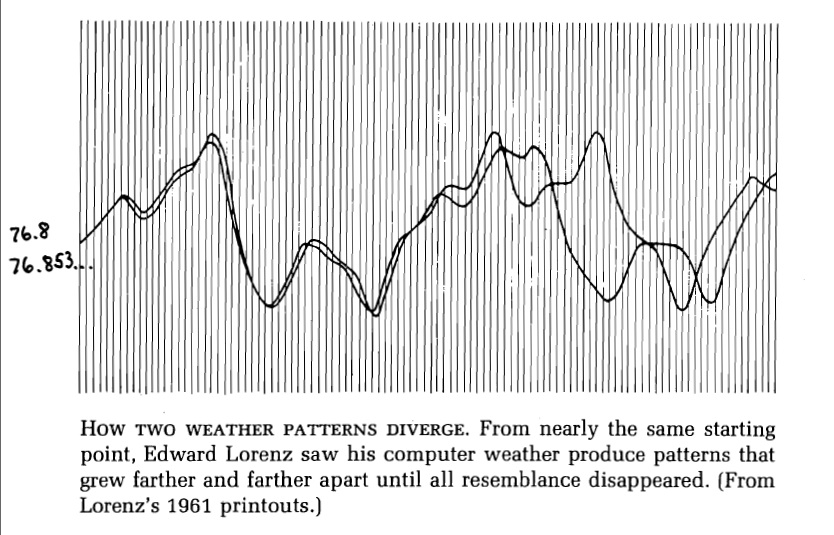
Lorenz’s printouts
The butterfly effect is scientifically (and boringly) called, ‘sensitive dependence on initial conditions’. The analogy drawn was that a butterfly flapping its wings may end up giving rise to a hurricane halfway across the world. It says, small perturbations can cascade into massive disruptions over stages. A chain of events can soon derail from predicted paths. You may have heard the following adage in your local language –
“For want of a nail, the shoe was lost;
For want of a shoe, the horse was lost;
For want of a horse, the rider was lost;
For want of a rider, the battle was lost;
For want of a battle, the kingdom was lost!”
– James Gleick, Chaos
Gleick’s book traces the history of this subject from Lorenz to a line of over 200 scientists who added to this new field. Chaos Theory upended existing beliefs about nature’s working – we had assumed what was simple, worked simply, and what was complex was well, complex. Chaos Theory firmly established that Simple systems can give rise to complex behaviour. Complex systems can give rise to simple behaviour. And that laws of complexity are universal.
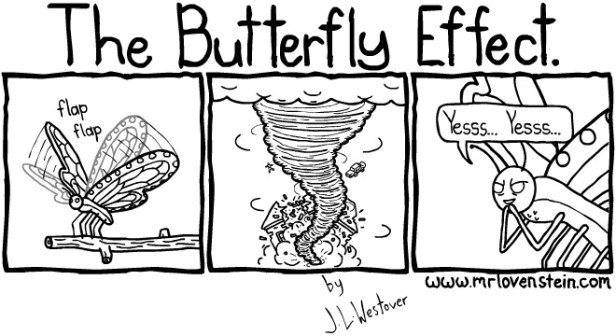
The diverse field of Chaos Theory is based on the following tenets –
- The Butterfly effect – that small changes add up over time to birth massive changes
- Unpredictability – because we can never know all the parameters perfectly and there may be hidden errors, it is not feasible to give an accurate prediction, like weather forecasts
- Order/Chaos – Order and chaos are not binaries at the opposite ends but are often separated by a thin boundary that occurs in surprising ways, like the dripping of water turning into an aperiodic stream
- Mixing – Two points in a system can end up in completely different positions over time; think of a water drop in a bucket after being stirred vigorously
- Feedback – systems become more chaotic with feedback coming in, like stock market returns influenced by current sentiment
- Fractals – recursive, never-ending patterns and the source for the aesthetic beauty of chaos theory; think shapes of snowflakes and patterns on leaves
In recent decades, research in science has worked the following way – established people in defined fields pick up specific problems and choose a particular aspect to explore or refine, researchers and students are hired to work on it, a number of publications result from this collaboration which secures funding for the foreseeable future, and also serves the purposes of the funder and keeps others financially afloat. But this method comes at the expense of those willing to straddle boundaries.
Rob Shaw, one of the leading contributors to Chaos Theory in the 1980s, said, “We had no advisor, nobody telling us what to do. We were in an adversary role for years. We were never funded at Santa Cruz. Every one of us worked for considerable periods of time without pay, and it was a shoestring operation the entire way, with no intellectual or other guidance.” His group recalls being taken aside one-by-one by concerned peers who reminded them that they needed to get their dissertations done, tenure secured, funding received and their tinkering with an idea that had no domain, no vocabulary, no authority, no defined problem, was likely to jeopardize their promising careers.
Chaos Theory was birthed a cross-disciplinary child of multiple domains, whose parentage cannot be reduced to a single field. Of the 200+ scientists who worked on it, they were, amongst themselves, meteorologists, mathematicians, biologists, astronomers, quantum physicists, ecologists, and others. Furthermore, they were all people willing to step outside the confines of their own fields, straying from their specialities. Most of them had to fight against norms and hold on to a sense of curiosity that was not boxed by their academic boundaries.
We forget that science doesn’t live in labs and equipment. It is understood there. The stepping stones to understanding chaos in these “dynamic non-linear systems” came from the following sources – wanting to predict weather, seeing how populations of insects behave over years, why Jupiter’s Red Spot didn’t dissipate among the numerous storms it endures, why epidemics came in cycles, how the shoreline of a country tends to infinity if you observe closely and start measuring the contours of each speck that lines the water, why two snowflakes never resembled each other and many more such lines of inquiry.
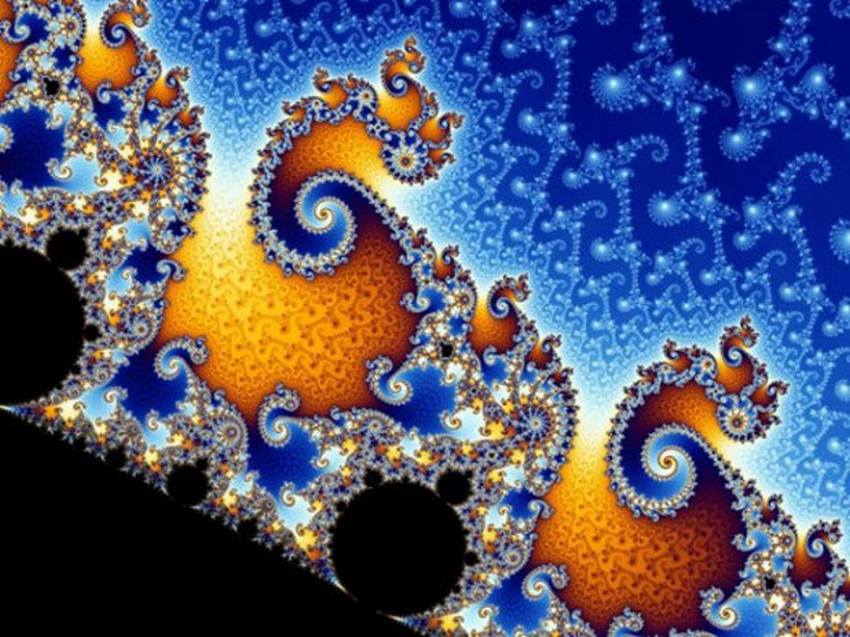
Unfortunately, we are taught to compartmentalize ourselves from a young age. The education system is set up to teach you subjects in silos. One is expected to specialize over time. So, I understand why Chaos wasn’t even mentioned at school. We are taught fundamentals at school and given a basic toolkit to see a subject through. But if the purpose of education is to spark curiosity, it is precisely things that arise from chaos theory that need to be discussed – it will take one video depicting a visualization of the Mandelbrot set to strike the fancy of kids. It is so aesthetically pleasing and thought provoking; the idea of fractals folding into each other to yield an infinity of points that open into deeper infinities.
A repeating theme that I’ve written about in this series of articles has been that of bringing a new idea to a resistant audience. It’s disappointing that this was the case here too, considering that this field opened up effectively in the second-half of the last century. But let that not be the last note for you readers. If you must take away something, it should be the undying spirit of people to find order in this entropic world. To treat knowledge as a tapestry that adds stitch upon stitch, a jigsaw puzzle where thousands, if not more, slave away to piece together something beyond their grasp. That people, in their limited years can create words, theories, subjects that can incrementally explain the world around us, peeking behind nature’s magic and exposing the magician’s sleight of hand. That no matter how much we think we know, nature can always surprise us. And that, everything around us, no matter how deceptively simple, is a fractal. We just need to look closer.
PS : I am planning to make this a series of articles about people/things/events that were part of our syllabi in school but left out some really interesting stuff about them. If you have recommendations, please share them in the Comments below.
Sources
[1] Chaos : Making a New World by James Gleick
[2] https://fractalfoundation.org/resources/what-is-chaos-theory/
[4] Veritasium – Science Behind Butterfly Effect
[5] Numberphile – What’s So Special About the Mandelbrot Set?


WOW very well researched piece.
LikeLiked by 1 person
Thank you so much!
LikeLike
Simply awesome
LikeLiked by 1 person
Thank you so much!
LikeLike
I liked how you described..
“Think about water dripping from a tap. When you turn it on slowly, it drops in an aesthetically pleasing rhythm – an aggregate of hydrogen and oxygen coalescing into a bulbous shape, pulled by gravity, falling into the sink”
” To treat knowledge as a tapestry that adds stitch upon stitch, a jigsaw puzzle where thousands, if not more, slave away to piece together something beyond their grasp. ”
This is an article that makes you curious to read more.
Too good
খাঁটি জ্ঞান
pardon for the above words, its a google search for PURE KNOWLEDGE!
cheers to life
LikeLiked by 1 person
Thank you so much for the kind words. I really appreciate them. Cheers.
LikeLike