An article exploring the legacy of Mrs. Shakuntala Devi and the questions raised by women pioneers
“Human memory is not merely the repository of information in the brain. It is much more than this, and something that a machine can never be: a power, a force by which we mentally reproduce not just information but also our experiences, by which we shape our perceptions, introspect, interpret and analyse the direction our life has taken.”
― Mrs. Shakuntala Devi, Super Memory: It Can Be Yours
I watched the biopic on Mrs. Shakuntala Devi, starring Vidya Balan yesterday. The movie was a good albeit overdramatic attempt at exploring the woman who was called The Human Computer. Every biopic has a narrator or point of view that serves as the ‘in’ for the story – the lens through which we are introduced to the subject. Mrs. Devi’s was her daughter and their flawed dynamic. While I liked the idea of portraying her as a complicated figure – a genius par excellence, a feminist ahead of her time, an overbearing mother, a stubborn trailblazer, I was left wondering about this emphasis on domesticity. A review on Deccan Chronicle captures my thoughts.
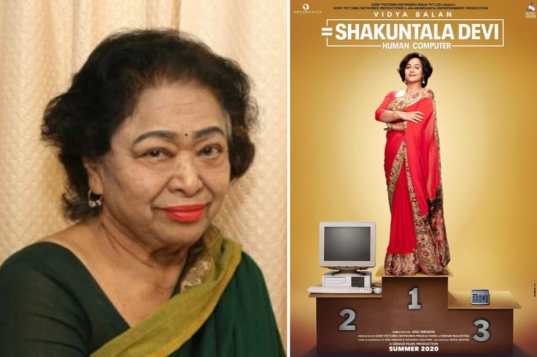
The biopic on Mrs. Devi. Source : News18.com
“Biopics of men also often venture into the personal, but they are not contained within that one narrative, one point of view. There are more voices, more points of view. Imagine if the story of Sachin Tendulkar was told primarily through the eyes of his son? Or the story of Ram only through the voices of Luv-Kush? That just won’t happen. And yet, in the case of women, it often does.”
– Deccan Chronicle, Shakuntala Devi, A Feminist Woman in a Sexist Setting
Was domesticity the biggest challenge for Mrs. Devi? Why was a complicated motherhood a character judgment for her but fatherhood not for her spouse? How did she prepare for all the pivotal moments that defined her career? What was she thinking when she felt the world, and certainly India’s eyes on her? Sadly, the movie answers none of these questions.
Mrs. Devi was born in 1929 in Bangalore. The apocryphal tale about her is that at the age of 3, while playing cards with her father, she beat him when she memorized their order. Soon she started earning money for her shows and had to forego formal education. Following a bunch of international tours, she gained fame in UK when she started getting booked for TV and Radio programs. The Indian human computer was ‘discovered’ by foreigners. It may be tempting to think that she was a product of a family ahead of their time but it was penury that forced her into showbiz.
“By 1952, her whirlwind tour landed her in the US. But media attention was sparse, and she felt the pressure of being her family’s sole breadwinner. She saved paltry sums from her ‘performances’ for herself and sent the rest home. Her meals at local cafeterias, she recalled later, were “soups” made of water mixed with free ketchup.”
-Indian Express, Why Shakuntala Devi Was A Woman Who Wanted It All
Shakuntala Devi’s mathematical genius was a rare gift. A psychologist, Arthur Jensen ran a bunch of tests on her in hope of finding some answer but it was to no avail. Mrs. Devi though, was not as fond of her trademark acuity. She spoke to the Boston Globe in 1976, “Of what practical use is it, really? It has just a limited appeal. I’m not particularly interested in math. What we need is more humanity.”
Another part of her life that the movie glossed over (and rather suggested that it was falsified) was her marriage to a homosexual man. Mrs. Devi, in 1977, wrote The World of Homosexuals, the first book in India that dealt with this issue. Unsurprisingly, she was criticized for it, for she advocated for complete and unconditional acceptance for the queer community in society, predating the Indian Supreme Court by decades.
I can’t say that I hadn’t heard of Mrs. Devi in school. I was gifted a book in Class IV called 101 Great Indians. In it Mrs. Devi occupies pages 197 & 198. But she was nowhere to be seen in my curriculum. The irony of her absence is that I was predominantly taught by women throughout my schooling years. Male teachers were rare. What makes her omission stranger is that she authored a bunch of books on mental math calculations, a rage in Indian schools with their emphasis on ensuring that children know tables, squares, cubes, and basic arithmetic up till the number 20. Her subject and her approach were both conducive to the education format.
In my course of reading for this article, I chanced upon a curious fact. In 1933, Nobel winner Mr. CV Raman refused Ms. Kamala Bhagwat (a Bombay University topper) to research with him in biochemistry because (no points for guessing) she was a woman and would ‘distract his male students’. The reason I bring this up is because this was very much the social atmosphere in which Mrs. Devi attained financial independence, advocated for LGBT rights, raised a child, and became an Indian icon that Mrs. Indira Gandhi called “a roving mathematical ambassador”. At a time when even Nobel laureates versed in Science and logic could not escape sexist, patriarchal tropes, she lived a free-spirited life and reinvented herself, particularly through writing multiple books – on Mathematics (Book of Numbers, The Joy of Numbers), Crime Fiction(Perfect Murder), Astrology(Astrology for you), and Self-Help(Super-Memory, It can be yours).
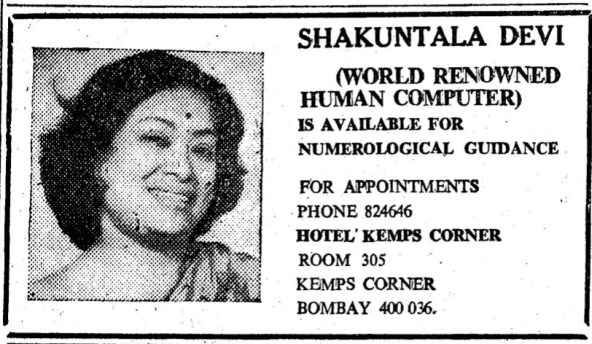
Mrs. Devi kept reinventing herself, becoming an astrologer in her later years. Source : Times of India
It’s surprising to me that she isn’t featured in the curriculum because women innovators in textbooks are already limited. Indian women innovators less so. Any time you erase representation of gender, sexuality, class etc. you risk constraining someone’s ambition and imagination. Mrs. Devi’s talent came to popularity out of a financial need more than her father’s kindness to share her gifts with the world. That’s why she wasn’t even allowed formal education. I wonder how many Shakuntala Devis stay lost in domesticity because their parents could afford not to put a financial burden onto their daughters’ talents.
Mrs. Devi doesn’t get credit for making math seem magical. Her innate calculative ability is certainly unique and incomparable but she’s not seen as a ‘mathematician’ in the leagues of Aryabhatta and Ramanujan. Why? Because she didn’t create theorems? Because she didn’t author research papers? Why is her talent reduced to a carnival attraction – pay to see her calculate and marvel?
Sadly, there is no authoritative way of answering these questions. There is no comprehensive biography on her and even though her daughter was consulted for close to 3 years for the biopic, the movie left out many questions that I posed a few paragraphs before. Even so, I would suggest that you watch the movie, if not for the Bollywood treatment of a remarkable figure, then for honouring the woman whose legacy was deemed important enough to be made into a commercial movie. If the movie can’t answer our questions, let’s hope it lets us ask better ones. That’s somewhere to start from, isn’t it?
PS : I am planning to make this a series of articles about people/things/events that were part of our syllabi in school but left out some really interesting stuff about them. If you have recommendations, please share them in the Comments below.
Sources
[2] https://science.thewire.in/the-sciences/shakuntala-devi-arithmetic-world-of-homosexuals-humanity/


Proud of you.
LikeLiked by 1 person
Thank you 😁
LikeLike
Yes it is sad that we talk about people’s achievements only after they pass away. Your comments about how many S. Devis stay lost in Indian society reminded me of Amrtya Sen’s article on Missing Women:
Amartya, Sen. “Missing women—revisited.” (2003): 1297-1298.
Sen, Amartya. “Missing women.” BMJ: British Medical Journal 304, no. 6827 (1992): 587.
LikeLiked by 1 person
Thank you so much for sharing this. I will read on it. Is it about the shortfall of women in proportion to the population of girls born vs. how many should have been born?
LikeLike