As I was writing this article, I was aware that most wouldn’t even click the link to read it. Some of those who did won’t make it past the first paragraph. I tried to think of ‘angles’ to pique interest, witty ways to rephrase our collective denial and failure when it comes to climate but couldn’t conjure any. So here’s a straightforward musing on a topic that elicits little banter and social currency – Climate Change.
This month I set out a task, to read more about environmentalism and climate change. I went through six books in total – Small Is Beautiful by E.F Schumacher, Animal Liberation by Peter Singer, Timeless Simplicity by John Lane, The Great Derangement by Amitav Ghosh, The Ecology of Commerce by Paul Hawken, and Walden by Henry David Thoreau. Between them, respectively, they covered aspects like reimagining economics as beyond profiteering and growing into larger entities, reconsidering our attitudes towards animals as food and research material in labs, rethinking our need to invest in materialism to derive self-worth, recognizing that our literature, history, and politics all played a role in downplaying the magnitude of the problem, realizing that unless businesses wake up to climate change, no amount of 3R’s at household level will do much, and that reconnecting with nature is an inherent need for all of us.
My own interest in Sustainability did not come about out of concern for the planet. It was coincidental. In my exchange semester in France, I picked the stream of ‘Global Business & Sustainability’, not out of curiosity but because it had no written exams and I was free to roam around Europe with my friends. But working on an assignment on the Chocolate industry in one of the courses, I was surprised to learn that nearly 90% of the chocolates we ate were likely to have had child labour involved. I’ll append the report in the Sources below.
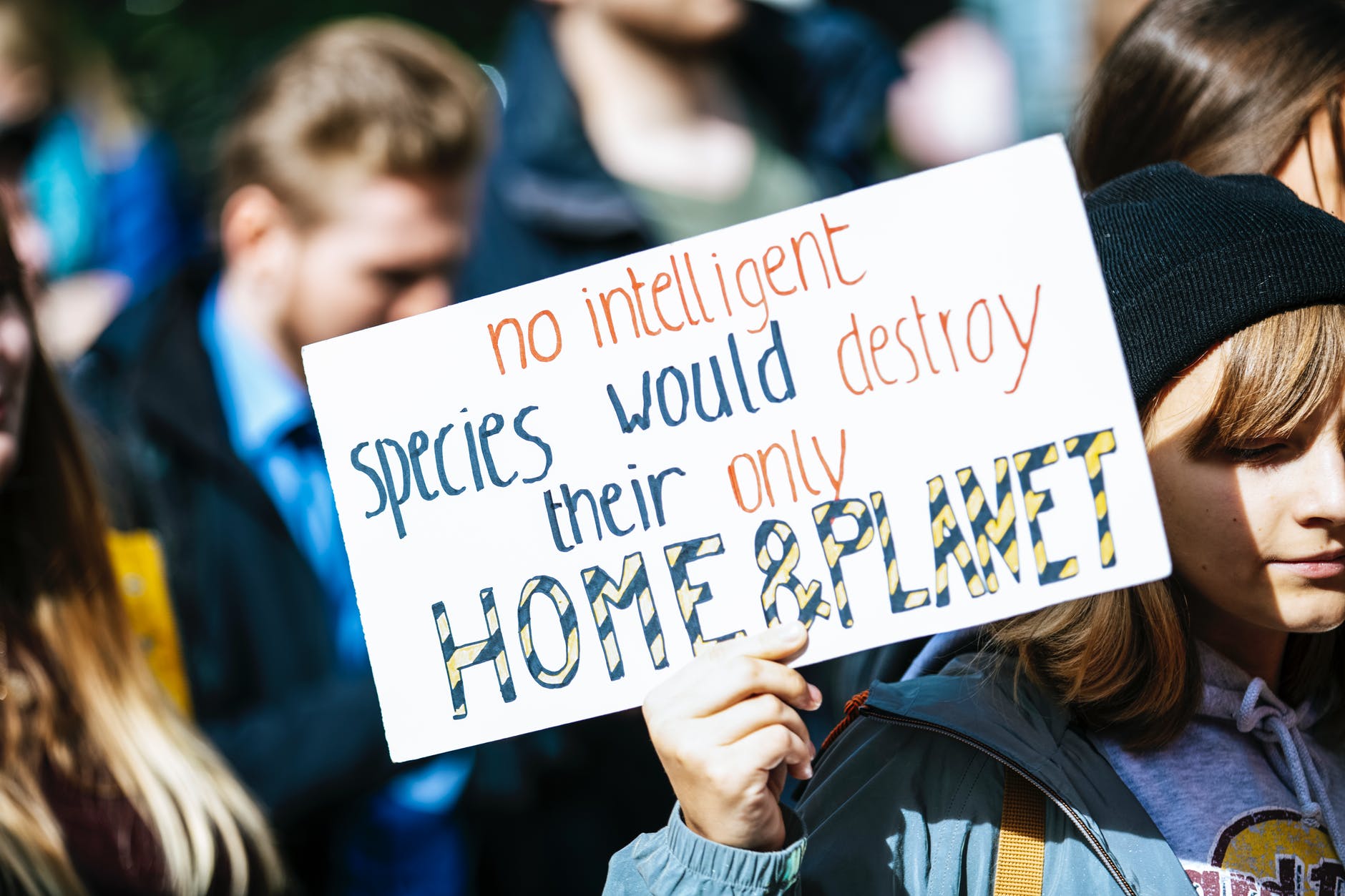
My experience with Climate Change had been that one was supposed to read on it, feel sad and powerless, and move on to other issues at hand. That’s what I did in school. My brush with this subject in school was in passing. A history chapter on Chipko movement comes to mind. Geography taught me Climate as a phenomenon and how waves formed and monsoons happened and the Westerlies occurred and that El Nino was a thing. Civics taught that movements and protests were expressions of democratic dissent. But that all of it could collectively stand for something much more than what my lifespan could comprehend, that epiphany eluded me. I recall we had ‘Hobby Clubs’ that we had to partake in. Most of us ran to ones which didn’t ask of much physical labour unless it was Sports. There was a gardening club but it was an unsaid rule that one was to take it only if one had ran out of options. The prospect of digging the soil and planting saplings in the Delhi summers was not inviting to those of us who looked at the Computer Lab with yearning because it housed an AC.
It’s not tough to comprehend why we don’t care. Most of us living in cities(“urban jungles”) are disconnected from nature, save for fancy plants that line our balconies. Many don’t have an ancestral tie to a village where nature is abundant(I certainly don’t). And we don’t have time to care. Between jobs and mortgages and socializing and driving and raising families and Marie Kondo-ing our possessions, who cares if a few thousand trees fall here and there. Our lives are embodiments of the thought experiment – “If a tree falls in a forest and no one is around to hear it, does it make a sound?” except that our answer seems to skew towards No.
What’s curious is that we haven’t lost the ability to admire nature. It rains anytime and most of us wax poetic on Instagram. We’re willing to pay to go to quiet resorts that offer serene backdrops of mountains. We want to experience quietude. We want fresh air. We want organic, healthy food. We bemoan pollution. Why can’t we participate in the movement to do all that?
The EIA Draft 2020 was subjected to ample criticism and by collective action, it has been stalled for now. It took millions of emails to get the attention of the ministry towards public dissatisfaction with the provisions within. But sometimes that’s all can it take to be heard. To send an email from your home. Our perception of activism and activists is coloured by those who lobby against it. Environmentalists are incorrectly labelled as militant marchers, eccentric hippies, and violent protestors. People resort to labelling others to reduce them to concepts they can discard. It takes effort to know someone to be a parent, an employee, a citizen asking for something he believes in, and tell them to screw off. It’s easier to call them a hippie and do away with their cause. Companies have spent millions of dollars in discrediting the entire climate change movement, harassing activists, and producing lopsided research, rather than changing their ways.

But who is to gain from this denial? Companies? Shareholders? Investors? Consumers? Why don’t we wonder why are middle-aged honchos going out of their way to bully a Swedish teenager when she raises questions? We forget that climate change will wipe out more than glaciers and ecosystems. It will wipe out us. The most vulnerable ones first. You look at it any which way – scientific proof, anecdotal experience, global movements, the piling evidence is clear, Climate Change is happening.
It can be overwhelming when you start reading on this. I’ve personally felt helpless after reading reports and books on mistreatment of animals, of exploitation of labour, of penny-pinching practices causing deaths, of careless disposal of waste leading to cancer outbreaks. It seems as though you’re a tiny human against a gargantuan Kafkaesque system but it needn’t be that pessimistic.
Companies push consumer demands as shields to defend status quo. Consumers feel their personal preference won’t do much for a company. There’s truth to both sides. But as participants in a capital economy, we are constantly signalling to brands. Every toothbrush, biscuit, chocolate, almirah, car, house, online subscription bought is an implicit nod on our end. When you shift from something as simple as packaged food to fresh produce, it’s both encouraging and a deterrent to different companies. And everytime you exercise this choice, you amplify it. You get 5 friends to do it, that’s also amplified. You can be Erin Brockovich from your homes. It’s possible. But if you don’t consider making a change out of laziness or convenience, then we can’t go anywhere.
Even if you take the plunge, it can be confusing. Does it help to purchase something organic that is flown from across the world? How do you switch to public transport if you don’t feel safe in your city? Is it ethical to eat meat that isn’t procured from a factory farm? Can you still use companies to buy cheap stuff given their patchy record of employee mistreatment? There’s no easy answer. Also, the agency to make a choice is itself a privilege not present to all. It can leave you feeling confused and guilty.
To be fair, companies have also begun to take notice. Most on the Fortune 500 list have a department catering to Sustainability (whether it’s only for show, is up for debate). There are stock exchanges that have come up catering to sustainable investments. Much as how saplings sprout from within walls, environmentalism and capitalism have started to forge an existence together. There are companies, start-ups and initiatives that cater explicitly towards Climate betterment, energy reform, food supply chains, and eco-friendly establishments.
I suspect at a species level, it’s tough to realize this problem because we see ourselves as conquerors of nature. Not only do we sit atop the food chain, we made the concept of the food chain. To think that we have to share what we thought we owned, is a humbling feeling. But it doesn’t take humility to realize that an earthquake, a tsunami, a flood, and a draught can bring all our systems and structures to a halt. Currently, a puny, microscopic virus has done that.
If you’ve given me your time to read until here, Thank You. It’s not a ‘sexy’ topic. It’s not fun to discuss over dinner. It’s not what acquaintances love to catch up over the weekend. It’s easier to brush it under the carpet. But it’s happening around us as we speak. Burying our heads in the sand is not going to erase it. It is time to take up un-sexy topics to educate oneself. To conclude on another forest based metaphor, to miss the forest for the trees, is not something we can afford, for due to our denial, there may no longer be trees, nor forests. What will shareholders do then?
Sources on Climate Change/Sustainability
- Report on Chocolate Industry
- Podcasts
- Websites
- Magazine
- For My Reviews of the Books Mentioned


As a climate change researcher, I would also say that a lot of the fault lies with scientists who published their findings in prestigious journals but did little to communicate in simpler terms with the larger population. However, scientists are not best known for being star communicators which maybe we should all think about. At least I am trying to do that myself in my own small way.
LikeLiked by 1 person
That’s so cool that you’re a climate change researcher yourself!
I agree with you in that we mistake simple communication for lack of depth or alternatively we see complex sentences as representative of clarity of understanding. Which is sad because it alienates so many people.
LikeLike