For the second time in a year, I attempted to read Rachel Carson’s iconic book Silent Spring. For the second time in a year, I stopped at page 115, unable to rein in my brain from branching off to its Lala-land as Carson wrote passionately about pesticides endangering all the facets of nature. For the second time in a year, I felt the pinch that I wasn’t properly taught to deal with as a kid, the pinch of quitting something.
Out of an infinitely large collection of books and texts, what was it about this harbinger of the modern ecological movement that gnawed at me?
It was Rachel Carson’s story.
When Rachel published Silent Spring, she was a respected, awarded ecologist and researcher. But publishing this book brought her at loggerheads with the entire pesticide industry and lobby that went out of its way to discredit her, using the standard pejorative that has been hurled against women for hundreds of years – ‘hysterical’. Not to mention Rachel was battling cancer all these years that she had to struggle to keep her credibility intact. Luckily, her book and credibility prevailed and of the many things that were credited to it, the banning of DDT in US was a prominent one. It was this that got me into the book. This notion of an earnest academic denting an entire lobby. Sadly, this was not in the book itself and the actual content with its elaborate descriptions of animals, insects, fishes, and trees set entirely in the American landscape that I hadn’t heard of, and had no reference for, soon took a toll as my brain just could not visualize what was being described. Unable to distinguish the chapters from each other and unable to retain the content of the previous pages, I had to quit.
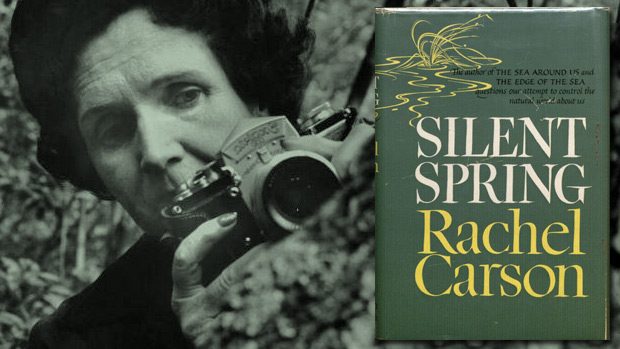
Credits : https://www.thenewleam.com/
Before Silent Spring, there were others. Emma. The English Patient. Love in the time of Cholera. The Waves. Dan Brown’s latest book Origin. All abandoned at varying lengths, sentenced to book purgatory where the possibility of picking them up again remains slim but not zero. Abandoned for various reasons. Emma for getting weary with people sipping on tea and discussing courtships and marriage. The English Patient for inducing endless unexpected naps. Love in the time of Cholera for moving at such a slovenly pace that I hoped one of the protagonists would catch Cholera. Dan Brown’s for simply having outgrown his formula which worked wonders for a 14 year me but not anymore. But none of them stung as much. Neither did Carson. She was just the conduit, the trigger for this train of thought. The one that stung, and continues to sting is Virginia Woolf’s fiction.
If you’re a regular reader of the blog, you would’ve come across quotes from A Room of one’s own in many of my write-ups. That essay shaped my attitude towards reading and writing, and occupies a pivotal place in my heart. By contrast, my inability to jostle with her prose disappoints me to no end. With other authors and their work, it was a question of my interest not being piqued enough. With Woolf, it’s an ego thing. I can’t read her prose because I don’t understand it. I feel incapable of following her stream of consciousness that weaves a labyrinth and marches ahead page to page while I feel so lost. It wounds my pride and intellect. It’s just a collection of words structured from the same alphabets. Why is it so hard for me to make sense of it? I don’t understand why I don’t quit her books. It wouldn’t take that much humility to concede defeat.
I think it’s the mythos around Woolf that makes me feel that I must get through her fiction once. Whether I like it or not is a separate thing. I think of Nicole Kidman portraying her in The Hours (“They should call this thing The Weeks” – Liz Lemon), prosthetic nose and all, walking into the river as the narration voiceover carries her letter to her husband, “Dear Leonard. To look life in the face. Always to look life in the face and to know it for what it is. At last to know it. To love it for what it is, and then, to put it away. Leonard. Always the years between us. Always the years. Always the love. Always the hours.” and I feel like I want to know more. I read about her and her battle with bipolar disorder and how she pushed through it to produce her work and it makes me want to see how it translates to paper. It is a perverse curiosity to want to know more about a tortured genius.
I have her books, some on Kindle, others in paperback. And I think of going back to them. Particularly Mrs. Dalloway which plays the connecting link in the movie The Hours(I haven’t read the book). Yet some shiny new or old book catches my eye and I put her aside, hoping time and age might mature me into a reader who will comprehend her. It worked for me with Mohsin Hamid when I picked his book after 6 years and felt I had grown into the experiences that it asked of me to relate with. Perhaps I hang onto this. That’s why I can’t give up on Woolf. Not yet.
It makes me wonder what is the sweet spot when one must quit a book. It can’t be when the first lull in the story comes for I’ve read many books that ended brilliantly. It can’t be when you can’t relate to something the story asks of you because how else will you acknowledge something different unless you see it happening? It can’t be because the language poses a challenge because it’s a way to grow. Thus the only way I make sense of it is that I must quit when I have the motivation to read, I’m willing to grapple with the language, and I’m ready to go with the story’s flow but my mind gives up far too often between pages. If I pick another book and am able to apply myself on all these accounts but going back to the previous one brings up the same issues, it’s time to reconsider.
To quit something feels so alien because it’s not something one is taught. The rallying cry of all well-meaning parents/guardians is to try something before you give it up. Other folks would have you believe that if you stick with it long enough, you can get anything. Perseverance. Dedication. Yada yada. Which is perfectly fair. But the challenge is in quitting something without diminishing your sense of self. It is to accept that something is beyond you without feeling lesser. And I don’t know how to do that yet. Even so, I must admit that I wouldn’t want to be able to read and understand every book that comes my way. A little bit of friction is conducive, even necessary. To fly through a book without having to pause for a sentence is equally concerning as not being able to understand something at all. There is something humbling about a book that feels out of reach, that can keep one’s pride in check. It’s something to aspire to. The more you read, and the more diversely you read, this sense of knowing so little is reinforced.
For some of the books that I abandoned, I caught up on summaries and podcasts that discussed them. That doesn’t count as reading them but I didn’t feel like abandoning the story halfway. Another remnant of the not quitting mentality perhaps? Speaking of which, there lie books scattered around my room that I bought aeons ago and I KNOW I won’t read but I can’t even get myself to give them away. In a way, I’ve quit before even beginning. They occupy space and gather dust in the hope that some friend of mine might chance upon and borrow them.
On the same lines of abandonment, on my laptop there is a folder where this article resides amidst the company of its published siblings, and others that will, in all likelihood, not see the light of the day. Were I to have a flair for the dramatic, I could scribble them on scraps of paper that would be scattered around my house, the sign of a creative force at play. But I am no creative force and I have no one else to clean up so they reside neatly in a folder, in the hope that somewhere, somehow, something will click and the pending, trailing paragraphs and sentences will find their overdue conclusions. It’s a struggle to let go of my scatterings of thoughts too! I think I can extend the argument to other facets of my life but I’m concerned it might trigger a severe bout of existential crisis. I’ll take a rain check on that today.
If you’ve made it until this paragraph, then hopefully your motivation, my language and/or the flow of this piece was capable of pulling you to its meandering conclusion.
Or perhaps you’re a victim of the ‘can’t quit’ mentality yourself and you pushed yourself to finish what you started.
Either way, I’m grateful.


If this was a multiple choice question then my answer would be: “Or perhaps you’re a victim of the ‘can’t quit’ mentality yourself and you pushed yourself to finish what you started.”
LOL, nevertheless I must say its a very well written piece.
LikeLiked by 1 person
Hahaha, thank you so much for reading.
LikeLike