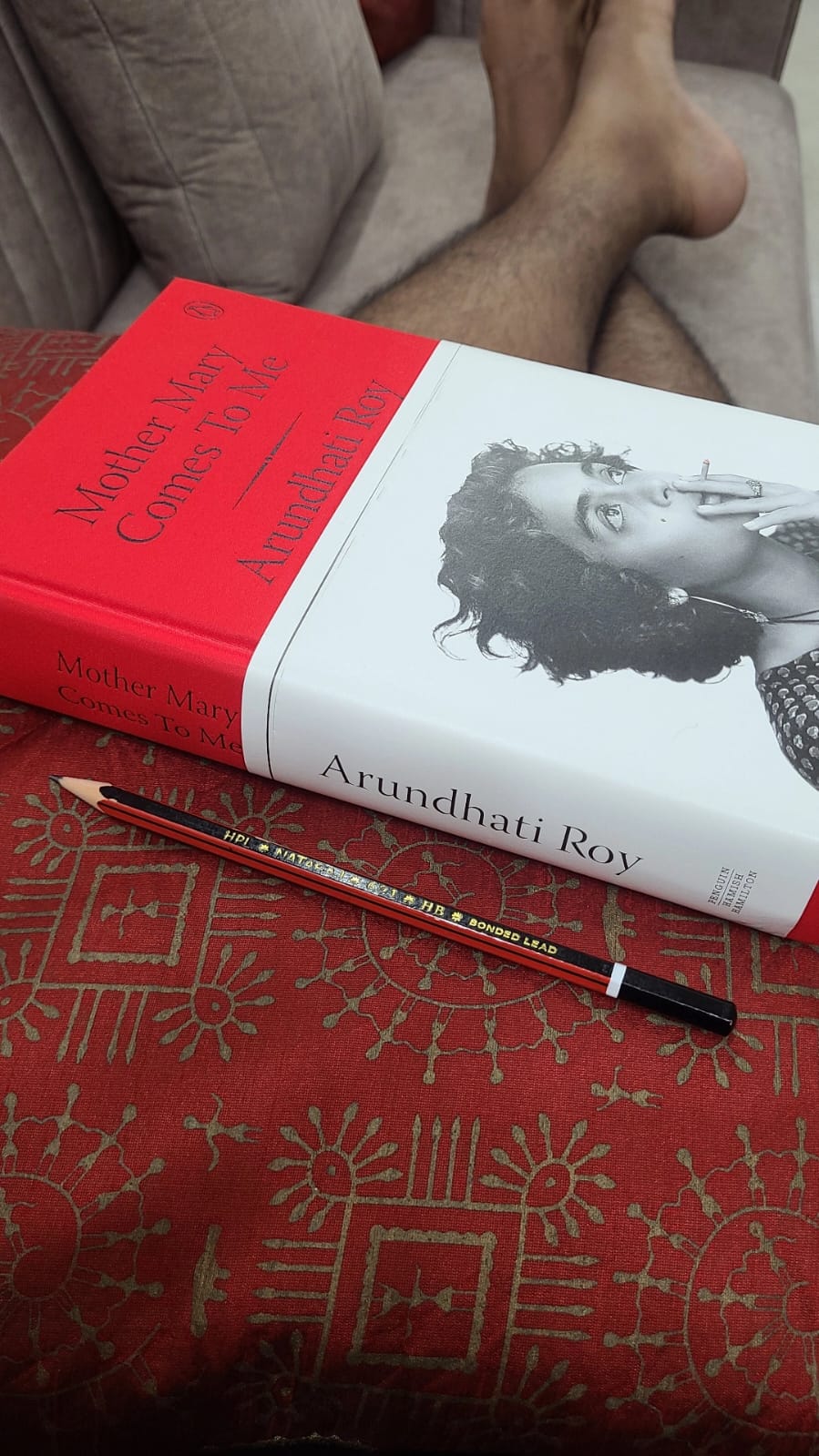
I spent the last two weeks reading Arundhati Roy’s memoir ‘Mother Mary Comes To Me’. It is a fabulous book written at the confluence of memory, identity, and literature. She captures the push-and-pull of growing up under a mercurial parent with microscopic clarity. She was raised by a firecracker of a personality in her mother (named Mary) who was an outspoken, combative, feminist divorcée in a time when it wasn’t ideal to be any of those things. I was drawn to Arundhati’s story, particularly the ages at which her milestone events occurred. Left home at 16. Married at 17. Divorced at 21. Remarried at 23. National Award at 27. Booker Prize at 36.
I have always found it fascinating to map the age at which someone’s big moment(s) happened. For a while, it was simply an idiosyncratic fad. Now, this habit is yielding an unexpected consequence – it is behaving as a clarion call from the great beyond.
Here is a list of what I paid attention to in the last month –
- Carlos Alcaraz won this year’s US Open at 22
- Aryna Sabalenka also won this year, at 27
- Omar Apollo had his big break at 25
- Janet Jackson released her breakout album Control at 20
- Jack Edwards, the famous Booktuber, hit a million followers at 23
I am currently 7 years away from being Arundhati’s age when she won the Booker but I am already 2 years older than she was when she won the National Award. I skip her weddings and divorces section; I do not aspire to an age limit there.
As a teenager, when I used to read the Wikipedia pages of people, their ages and achievements seemed so far into the future from the point of view of my youth. It seemed so natural that someone grew into a supremely successful version of themselves in their 20s and 30s, like watering a plant and waiting for it to sprout at the right moment. For that younger me, this promise of greatness was ahead at an unspecified point in time. And therein, partly, was the charm of growing older. To ripen into oneself, and to have one’s own money.
The world is, and has always been, youth obsessed. Though I am young by definition, I am more conscious of society’s relationship with aging, particularly its reverence for the young. You have people breaking records of being the youngest at something each year. You have the Forbes 30 under 30 list. It’s all speed, vigour, young, fast. Though I am not too far removed from my time as a college student, when I look at the kids in the Delhi Metro, the ones that appear to be in college, I’m surprised at how young they look. Mentally I do not feel that removed from them but I know I no longer pass for a college student. And the second you see signs of aging, you can’t help but notice the entire economy dedicated to propping up the facade of youth. For the right price, physical decay can be staved off. Hairlines can be regenerated. Wrinkles can be erased. Faces can be pulled. But I digress.
It is my belief that all of us have a modicum of creative energy within us, one that doesn’t have anything to do with the drudgery of life. It is a matter of how much attuned we are to that source and if we wish to channelize it. Whether it comes out as art is one thing. But insofar as we are aware of it, we should do something about it. A relative of mine once remarked that if I feel myself flowing with creativity, I ought to release it into the world regardless of consequence. Sitting on it would only alchemize it to frustration and regret.
It is painfully clear to me that if I want to alchemize my creativity and do something grand with whatever little skillset I possess, the “right” time may be slipping away into the past. But I roll my eyes at my hubris at aspiring to greatness (at what? I do not know) when I can barely slouch towards mediocrity on a good day. The Sisyphean ordeal of daily adulthood is wearying and relentless. I do not know how to keep myself creatively nourished and produce something fantastic in between work, chores, exercise, socializing, and getting sufficient rest. I, who used to be out-and-about in the city meeting scores of friends some years ago, no longer have that springiness of spirit. There is not a single aspect of my life where I am at peace with how it is going (with the exception of my habit of reading.)
In trying to keep it all balanced, I have started to disappoint people, including myself. I want to read and write and exercise and watch TV and spend time with family and catch up with friends and learn new skills and do chores and attend events in the city and take naps and bask in my solitude. And I have but two full days of the week at my disposal. Something has to give. I am beginning to hear thinly veiled complaints from others about not being prioritized. I do not take the wearyingness of adulthood of others as personally as much as mine is taken by them.
Where do I fit dreams of creative greatness in this schedule?
I also sense as though the sins of the past, inflicted on a much younger body, have held a grudge all this while and are beginning to demand a payback. I do not feel as sharp and energetic as I used to do. My stiff neck keeps reminding me to take breaks. The written word doesn’t come as naturally. Some names of acquaintances slip my tongue. Yet childhood jingles and Bollywood songs persist. The human brain is bizarre. This apparent slowness is not unique to me. My friends jokingly commiserate that after 25, they were suddenly reminded of body parts that they had taken for granted. It is the natural wear and tear of the body. There are no concessions.
As I read Arundhati’s memoir, I tried to find passages where she talked about precisely when and how she made time to write. I did not come across any sentence where an idea struck in the middle of cooking a meal or drying out laundry or cleaning her bookshelf. Within two paragraphs or so, her essays didn’t exist and suddenly they were already published and critiqued in public. How/when were they written? Who knows, maybe she had captured it but it was edited in favour of other things. The minutiae of the creative process may not intrigue every reader.
Let me make it clear. I am no Arundhati Roy. I am, however, curious about how greatness graces the doorstep of certain individuals, especially ones that also value other spheres of their existence, and how they welcome it into their fold and make a friend out of it. The single-mindedness of overachievers is impressive but somewhat limiting in understanding who they are when they are not doing what they are known for. I am drawn to who/how people are during their off-hours. I speculate that it might be easier to be fantastic when your food is cooked, clothes are ironed, and there is no day job to occupy 9+ hours every day. I want to know how greatness squeezes itself through the cracks when one is also a weary adult who simply cannot avoid the chores of being a functional human in society.
This life of repetition is entrenched in the psyche of the middle class as stable and aspirational. The idea is to secure the fundamentals of life, and to hold on to them for dear life. Insofar as you have a little of everything, losing out on dreams of greatness isn’t seen as some grand failure to launch. And it is in this cocoon of practical logic that the days seem long but the years pass silently. It essentially erases the question of age being a barrier when most days resemble each other. If you start at any point, you can create something. I am aware that many people have hit their stride in later years. Most politicians reach a career pinnacle in their 50s, 60s, and even 70s. Penelope Fitzgerald began her writing career at 58. Boman Irani got his big break in his 40s.
Therefore, once I make peace with age not being an issue, what I struggle with (the driver of the struggle bus) is not having a sense of what I wish to write. I have been writing for the better part of the last decade. Let’s assume it is in this field that I wish to achieve greatness. There ought to be some creative flint to light a spark. The God of Small Things came to Arundhati Roy as an image – of twin siblings sitting in a car in Kerala in the middle of a Marxist protest. Ever the architect, she mapped this onto the canvas of storytelling and earned a supremely deserved Booker Prize. I do not have any idea that I feel strongly about. Even essays on this blog have become sparse for this reason. I do not know if I have enough worth saying without wasting people’s time.
Which makes me ponder what lies in the genesis of creative work. Do people exorcise personal demons? Do they employ emotions they can’t convey? Is it akin to personal therapy? Can you simply create something for the sake of creativity and have it become a raging success? Can a lack of tragedy preclude the creation of “serious” or “good” art?
Is there a correlation between good art and a tough life? Arundhati Roy could conjure the hypocrisy of adults as seen through the eyes of children because she had lived through it. A lot of famous art has its roots in social inequity and personal grief. The Handmaid’s Tale rose out of Atwood’s travels and her command of history. Beloved is Toni Morrison’s message on the horrors of slavery. Even on TV shows where you have to demonstrate a talent, contestants turn up with sob stories. Not once have I seen someone who signed up just for the experience and had a perfectly solid life outside. I cannot recall an interview where a writer said that the idea of their much lauded work came to them out of boredom and they wrote it just to amuse themselves. The only exception I can think of is the writing of Frankenstein. If I can’t make something happen due to an apparent lack of misfortune to excavate from my childhood, I cannot blame my family for providing happiness and security. It’s an absurd allegation.
Nevertheless I do keep my journals, thanks to Patti Smith. While I may not have a lot of profound adversity to show, I write my silly little dreams and vague anecdotes and funny quips from friends. Is greatness lying dormant in those pages? Is there a vision I will conjure from those scribbles? Who knows? But I also find myself unable to do nothing. It makes me restless. I am a firm believer in constantly doing something, and so it shall be for the foreseeable future. I keep writing and scribbling and keeping notes, even if none of it makes sense. But in writing this essay, I have realised something else.
In her essay Devotion, Patti Smith decodes her compulsion to write. She says,
“..slowly I discerned a familiar shift in my concentration. That compulsion that prohibits me from completely surrendering to a work of art, drawing me from the halls of a favored museum to my own drafting table. Pressing me to close Songs of Innocence in order to experience, as Blake, a glimpse of the divine that may also become a poem.
That is the decisive power of a singular work: a call to action. And I, time and again, am overcome with the hubris to believe I can answer that call”.
Maybe this is why I read constantly and obsessively. The ordinariness of life drains me so much that I long for escape, to replenish my mind with images, visions, characters, stories. I want the creative fountains of my brain to overflow. I am searching for inspiration through osmosis. It is my belief that when a good idea strikes, your work ethic sustains you more than your creativity. I do not use the word passion because passion is fickle and lacks endurance by nature. It is your work ethic that can chastise and nudge you, and demand you to do what needs to be done. I imagine that this call to action from your inner voice arrives with the clarity of a still lake – you peer inside and dive, splitting time, age be damned. Therefore, I am in search of this lake in the forest of art. Greatness is a myth, an illusion, a mountain range I do not have the oxygen to climb. Meanwhile, I keep walking on the ground, head bent down, searching for mediocrity in a pool of water.



You have given words to what i always do. Whenever i see a number for an age, i unconsciously compare it to my milestones.
Sometimes i feel reassured, for having dodged the bullet, however juvenile that may appear!
And sometimes i comfort myself, that i have time with me.
Thank you. As usual it is a pleasure to read your articles!
LikeLiked by 2 people
Thank you so much for reading and writing back to us. I’m glad to know that you also pay attention to the same. What is it that you’re trying to achieve in terms of the creative aspect?
LikeLike
Mentally I feel I am still in young. You know, when you are fresh out of college the world gives you some grace to be naive. But the body doesn’t miss a chance to remind me that I am not.
I don’t know much about greatness, I do feel the urge to achieve it too. But lately I have been feeling content with not being great at something as long as I am still able to derive happiness from it.
Thank you for writing this, always a pleasure to read your posts. Much love ❤️
LikeLiked by 1 person
We are in the same boat, friend. My mind finds itself to be younger than what my body thinks. I’m glad that you are seeking your happiness. Much love to you and the kind comments you always leave on the posts. ❤️🥰
LikeLike
Another great writing. It made me think hard…
LikeLiked by 1 person
Thank you so much for reading!
LikeLike