You already know what this is about, don’t you?
It was through a friend’s sharing of a post on Instagram that I learnt about the saga of the (alleged) solving of the Navier-Stokes equation by OpenAI. It is unclear whether this was due to the computational resources at play or something sinister, perhaps peeking into someone’s work without their consent. Before I could calibrate my opinion, I was transported to a version of the 1980s where a faded pink-and-blue denim aesthetic followed me on loop; soulless eyes staring back, rictus grins from under teased, bulky hair. What bothered me was its cyclostyled nature as all pictures merged into one. It reminded me of this cracker Claire Devlin line [1] from Derry Girls –
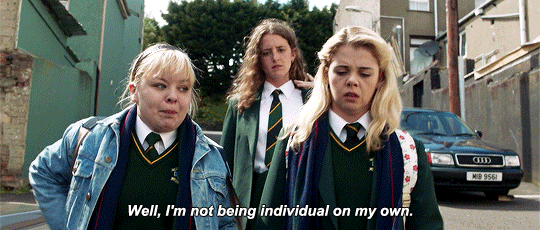
On the spectrum of crimes against humanity, pressing a button to request a piece of code to put your face on a picture is fairly benign. Know that I am not here to police your joy. In fact, I wonder if these trends are a marketing ploy to distract from the nefarious stuff – destruction of rare books, pollution of water reservoirs, damage to ecology, and ‘accidentally’ breaking the internet [2]. It is the big bad wolf dressing up as grandma.
If I wanted to dissuade you from using AI, I could give you big numbers on CO2 emissions, water utilised or energy consumed but I know that an appeal to shape opinions through the sterile touch of statistics is for school debates, newspapers, and academic journals. What piqued my curiosity was how little people’s curiosity was piqued when it came to themselves.
Why weren’t there variations on the clothing or hairstyle or accessories?
Why did so many seem to be seated in the same bedroom?
Why were people happy to be flattened into digital mulch?
Is this slop (if I borrow the term), this regurgitated pastiche, how we imagine ourselves?
This desire to ask AI to envisage ourselves in another era speaks to our inherent kinship with art, that we will happily become commodified replicas in the spirit of honoring some type of imagination, human or otherwise. But AI has no imagination because for it, you are simply a pulverized array of 0s and 1s that resembles a word in its dictionary called ‘human’. It has no consideration for your uniqueness. You are a data point that is absorbed into its incinerator and spit out as ash. I am offended on your behalf.
It may have taken you a mere minute to type the prompt, download the image, and upload the Insta story. Yet that irretrievable minute is a price that you have paid. All art has a cost attached to it, the most benign yet profound being time. I will never gain back the time I spent writing this and neither will you (if you are still reading). Is there anything of value in your life that has cost you nothing, not even time? What does it cost AI to compress you into a template? Nothing.
The mark of any artist (and/or their art) is what they pay attention to. If I offer the view from my window as a prompt, different artists will create completely different compositions, some highlighting the azure silkiness of the sky, others the drabness of the concrete, and some the shimmer of the human spirit. I do not know if anyone who participated in the trend was disturbed by the AI’s incapacity to see them, that it denied them their singularity and produced copy after copy within seconds.
I am equally unsettled by the consequences of contributing to a technology that can toy with reality. It may not be replicating your likeness with startling accuracy today but with every iteration, you are giving it power to produce a facsimile of humanity. In the near future, we will face a situation where mankind will have to spend time and money trying to establish what is real. These harmless fabrications of the 1980s will come back to haunt us.
This innocuous trend also hides how this ‘art’ is produced which is through infringement and plagiarism, both things for which most of us would have lost our college degrees. Writers have already complained that their legal copyrights were trampled over to be used as training fodder for AI. There is said to be a code of honor among thieves but this thief has no honor, only code.
I am prejudiced. I confess that a part of me finds people less interesting once I learn that they regularly lean on AI. In the canvas of my mind, an axis of their personality collapses, leaving no debris. It leads me to speculate that they stay at arm’s length from curiosity and wonder, want answers handed to them without intellectual friction, have no patience for the labor required to create something, and prefer not trying things to failing or being disappointed.
I feel this way about AI use because of my long-held belief that all humans have a modicum of creative energy, one that persists despite the drudgery of life. Whether it alchemises into art is a matter of how attuned we are to that source. While discussing the act of creating art, the writer Michael Cunningham wrote in his memoir Unsayable – “You want to conjure everything from the tint of the light to the tone and agitation in the air itself; to convey the life that brought you to that moment, and the unknowable life ahead. We can only measure our efforts by how close we’ve come to, or how short we’ve fallen from, aliveness.”
Anyone who has dabbled into a creative skill knows this gap, and also knows that to become better is to iteratively (hope to) shrink this chasm. On some weekends, I take art classes where someone who has honed their skill over many years patiently guides me through the creation of a below-average work which is kindly received and praised by my loved ones. Every time I sit down to paint, in my mind’s eye I see my creation as a resplendent specimen, and every time, without exception, it flops. It requires so much effort to make bad art.
It took me an embarrassingly long time to write this down, first, as handwritten notes, then a draft, then another, and finally to conduct multiple rounds of editing. I could have fed AI some of my older essays and produced a mimeograph of my writing voice. Maybe it would have written it so that it could have gone viral. I would also have saved time. I felt that I owed it to my tiny slice of creative spirit that I tried and did it anyway, against all thoughts of its inconsequence. Perhaps that’s what we need to consider when we desire to shortchange ourselves with AI – what do we owe ourselves? What is the best that we can imagine for ourselves?
AI can replicate reality but it cannot conjure aliveness, only fake it. Man’s capacity for imagination has an aliveness that must not be cheapened. If you feel restrained by your imagination, make terrible art but make it yourself. Or ask a friend. Don’t outsource it to a piece of code.
To be a willing participant of your diminishment will only make you less interesting to yourself.
“Art is where what we survive survives.”
― Kaveh Akbar, “The Palace”


This resonated a lot. Your point about everyone in the 1980s trend being flattened into the same template is spot on, and it sums up why the pixel is no substitute for the person. It also made me think about how even the tools promising realism, like Image to Realistic, only smooth over an image — they never see the life behind it. Thanks for the reminder that the effort of making art ourselves, however imperfect, is where the aliveness lives.
LikeLike