“My God, I just remembered that we die.” – Clarice Lispector
Last month I read (and adored) Kaveh Akbar’s novel, Martyr! My friend and I had decided to buddy-read it. It took us longer than we had intended because jobs, travel and illness – all impeded our progress (this dash is not AI, I promise). Nevertheless, we kept peppering our Whatsapp chat with observations and voice notes, thoroughly engaged in Akbar’s fiction.
Martyr! (exclamation intentional) is the story of Cyrus Shams, a near-30, queer, Iranian poet living in Indiana, USA, recovering from addiction, and desperate to devote himself to a life that has meaning. A globalised denizen with a fleeting connection to his Iranian side, Cyrus is very much at a crossroads in his life. Still processing the senselessness of his mother’s passing in the shooting of the Iran Air Flight 655 (which I was horrified to learn was a real event), he is obsessed with death, dying, and the ideas that propel people to sacrificing themselves.
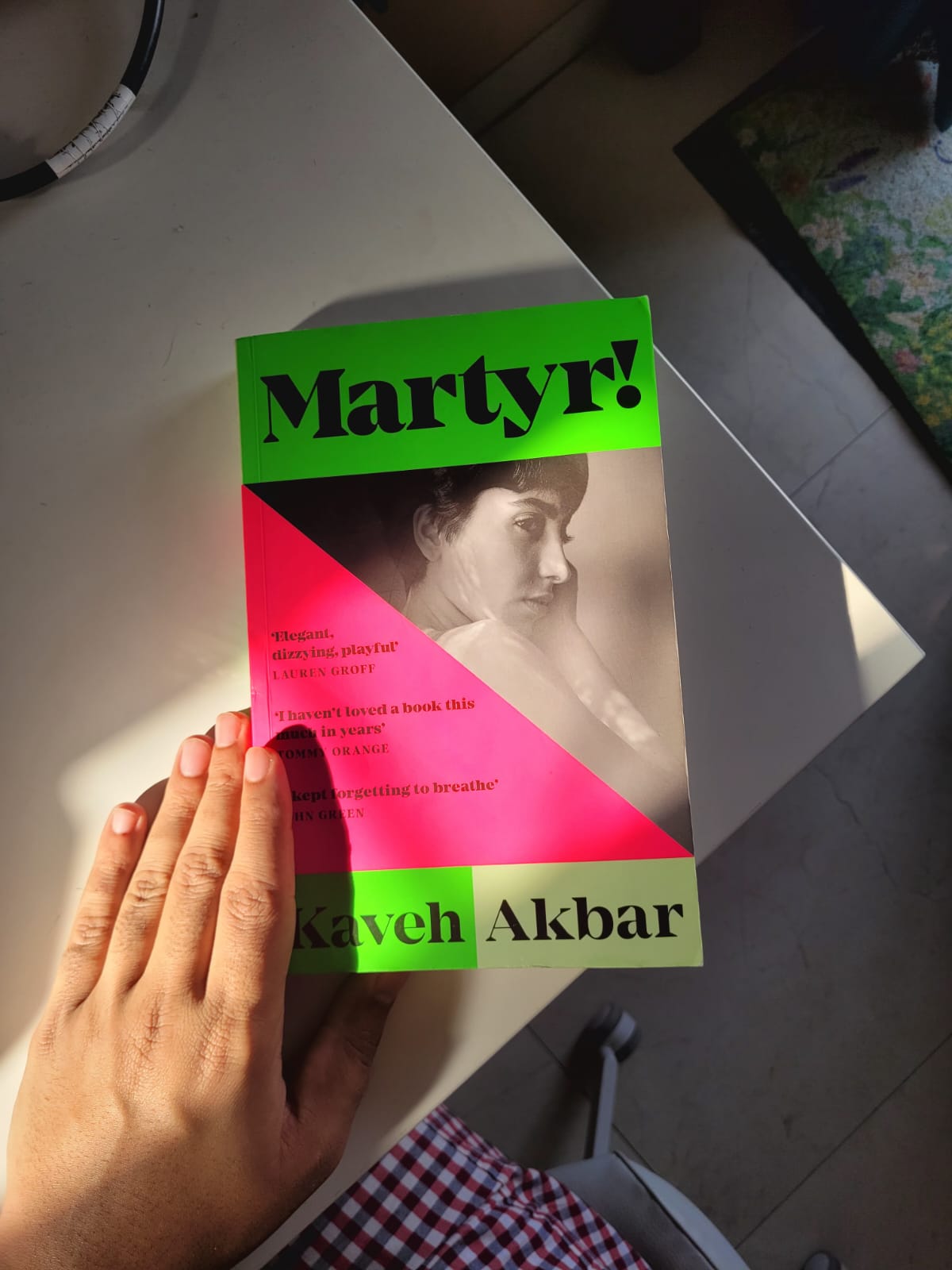
“My mom died for nothing. A rounding error. She had to share her death with three hundred other people. My dad died anonymous after spending decades cleaning chicken shit on some corporate farm. I want my life – my death – to matter more than that.” “You want to be a martyr?” “I guess. Yeah, actually. Something like that.”
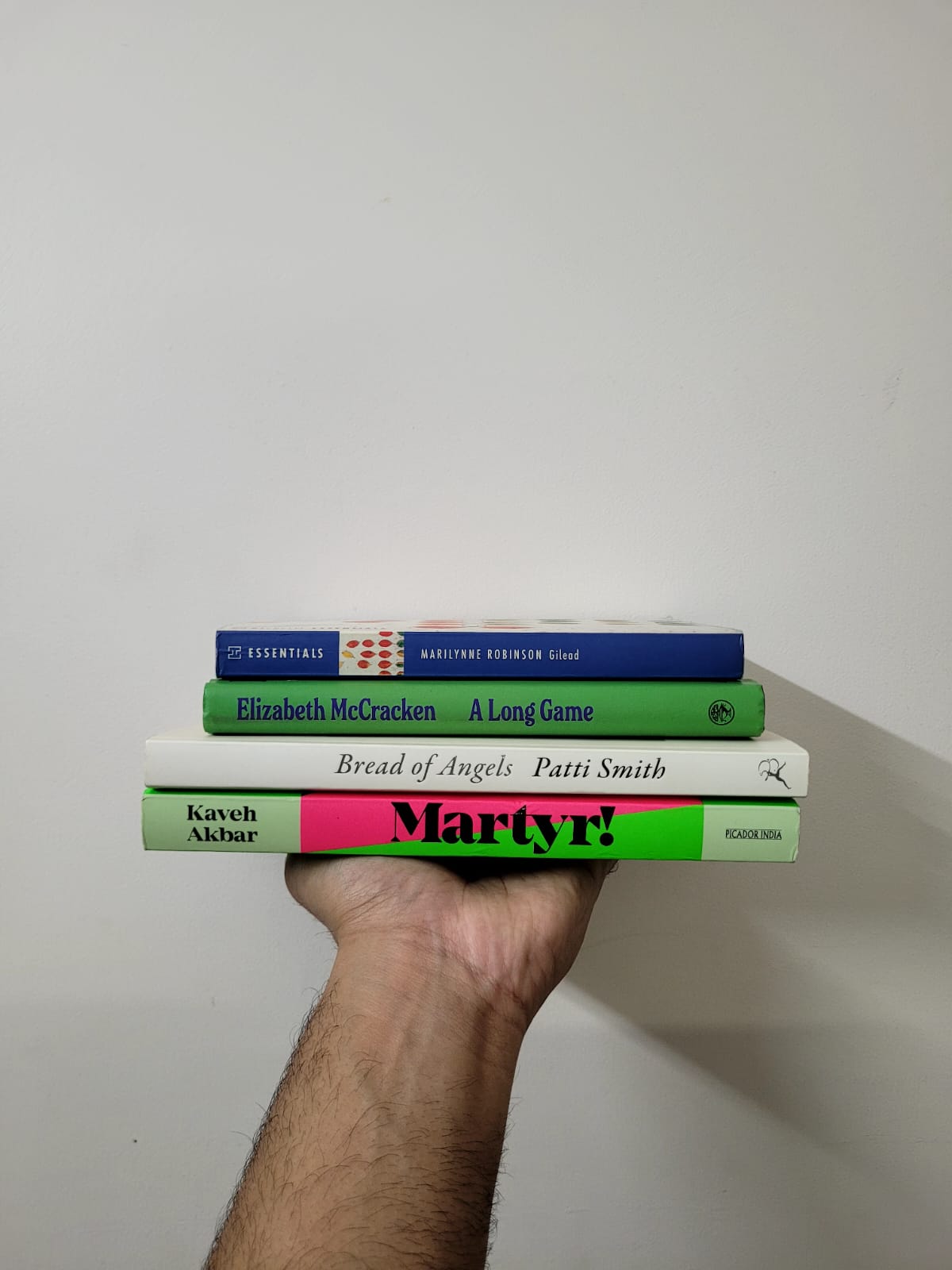
Cyrus isn’t unusual in his desire to find something worth devoting himself to. Humans have always had a tendency to narrativize their lives, to impose or search for an idea beyond themselves where there oughtn’t be any. I, too, have wondered how and why we chase meaning. Is the hunt for it an active pursuit that we shape day-by-day or the subtext of our actions that ties itself loosely to us? Or is it just a convincing story that we tell ourselves to rein in happenstance? Elizabeth McCracken’s ‘A Long Game’ sums it up –
“What is a human life other than the process of trying to answer, What just happened; what does it mean?”
Cyrus chronicles some martyrs in a word doc throughout the novel, perhaps to gauge what it means to be convinced of the righteousness of an idea or moral position, the complete absence of doubt. Yet it is an attachment to doubt that neither he nor I can let go of. I have wondered if I am too suspecting a person because my experiences on and off the internet have made me innately doubtful. It is an unrewarding trait – if you’re proven correct, you slip into cynicism; if wrong, you’re pessimistic, at best.
But for the believers (and whatever they believe in), I am curious as to how this well of conviction finds a source of water to flow into itself. As someone who has a cursory relationship with, say, sports, I am fascinated by how people find themselves drawn to resonate with others – individuals and teams, people they may share nothing in common with, certainly not a tax bracket. Sporting fanaticism isn’t even martyrdom unless you count the tragic deaths that occurred last year during the RCB rally as such; fans gathered in the hopes to catch a fleeting glimpse of their idols. Cyrus hints at something far less morbid, say, that if you’re a loving parent who has sacrificed to raise your children, you have, in essence, martyred a part of your life to the cause of parenthood.
Viewed thus, the intensity and definition of martyrdom takes a more positive guise. The avenues to potentially martyr yourself for constructive causes expand. Yet, one needs an epiphany for one’s calling. In the novel, Cyrus implores a higher power to flicker a bulb in his room so as to set him on the path to sobriety. In Patti Smith’s memoir, Bread of Angels, she recalls –
“My father set out looking for me and found me staring at a large Cubist painting…I was smitten by Picasso and for the first time I realised my father and I had strong conflicting ideas, and I had no qualms about defending my point of view…I obediently followed my father out of the museum but held fast to an invisible transformation; I had fallen for art.“
If you have followed her life and career, she has been a supremely dedicated artist with an uncompromising voice. I do not know if Ms. Smith has martyred her life for art but I cannot see her as anything but an artist. Sadly, this symphony of skill and purpose is something that very few of us are attuned to recognize when an opportunity presents itself. But hope persists.
To understand what you’re willing to martyr yourself for, I must borrow the much abused cliche – know thyself. And whatever you don’t have the answer for, you can consult the Oracle that holds the collective wealth of human wisdom, the search engine. But the way we experience knowledge has morphed in the last decade. I was having a discussion with some friends on the pervasiveness of AI and it was brought up that an over-reliance on it is leading to the shaping of a homogenized voice. They pointed out how a good slice of what we read online now is AI-written, and what we read informs how we speak. I do not know how much proofreading goes into correcting and re-training AI content but I, too, have been bothered by how people will type a query into AI and argue with an authoritativeness that neither they nor their AI can claim. What I see happening is an erasure of doubt.
How good is your belief in an idea which you do not wish to question? It may be an outdated example but so much of what I have learnt in school has come from friction, from being stuck at a sentence, from being unconvinced with the teacher’s statement, from wanting to hear the same thing spoken in a different way. To devote yourself to something, you ought to know it well, and for that, you ought to question it. I fear we may be outsourcing our intellectual inconvenience to a dangerous degree. I wonder if this has something to do with the abrasiveness of interactions between dissenting people. Unused to questioning, they find a disagreement with their opinion to be a primal attack on themselves.
I fear I have digressed. In Cyrus’s quest for greatness, I am reminded of a contrasting position presented in my current read, Gilead by Marilynne Robinson. I am re-reading it and in many ways, its narrator, Reverend John Ames, is an antithesis to Cyrus. Ames is in his 70s and reflecting upon his impending mortality. He gazes upon his life with a serenity that has no qualms about its ordinariness. In fact, the book is a celebration of it. He writes to his son –
“I’m writing this in part to tell you that if you ever wonder what you’ve done in your life, and everyone does wonder sooner or later, you have been God’s grace to me, a miracle, something more than a miracle. You may not remember me very well at all, and it may seem to you to be no great thing to have been the good child of an old man in a shabby little town you will no doubt leave behind. If only I had the words to tell you.”
In Martyr!, Cyrus conjures dreams between, say, his Mom and Lisa Simpson. I wish to envision one between him and Rev. Ames sitting face to face Jubilee style except there is no timer nor pressure to garner 1M views. I suspect there will be disagreement. I don’t doubt it.
I shall not reveal what direction Cyrus takes in the novel. That is for you to interpret should you choose to read this book. I will be happy to discuss it. It is apparent that this story has left a mark on me. It is my philosophy that a good work of art does one of two things – it teaches you something you didn’t know or it articulates something you did in a manner you couldn’t have done yourself. This did both.
“My God, I just remembered that we die”. “But-but me too?! “Don’t forget that for now, it’s strawberry season.” – Clarice Lispector


I will have to read this book…
Do devote a full column of yours to meaning of your existence ….or mine …..
LikeLiked by 2 people
Thank you for reading this. The meaning of my life, or yours, is pretty heavy to think about right now. Maybe I will do what Rev. Ames did in Gilead and wait a few decades for it to all make more sense.
LikeLike
I found myself nodding in agreement many times while reading this post.
Emotionally, I resonated more with Ames than Cyrus. I am going to read Gilead for sure, thanks for writing this!
LikeLiked by 1 person
I am sure you will love Gilead! I will bring the book over whenever we meet next!. Thank you for reading.
LikeLike