‘“Everybody lives,” Eddie said, because the creation of narrative tension was not his objective.’
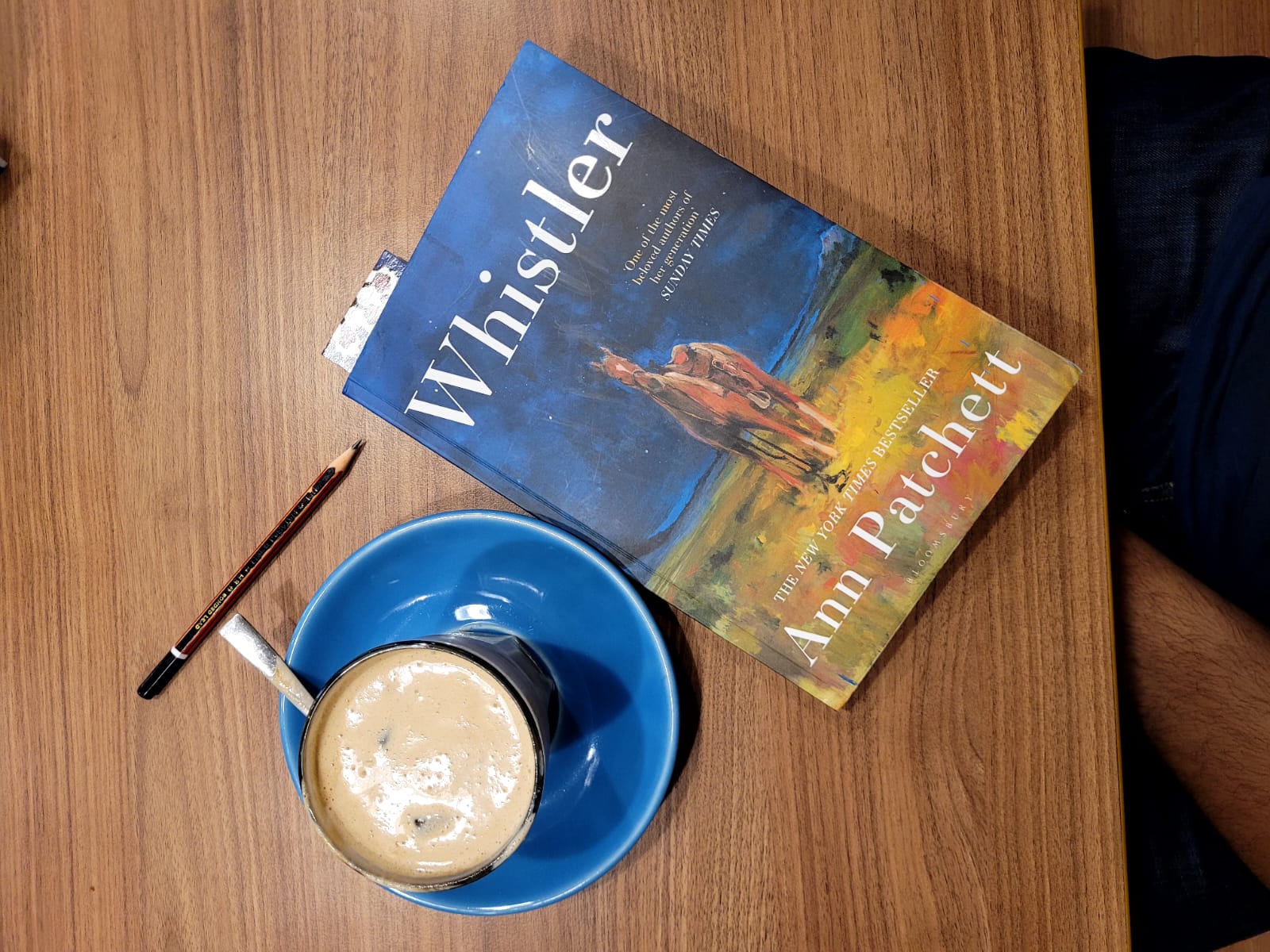
That pretty much summarises Ann Patchett’s ‘Whistler’.
Ambling through the Metropolitan Museum of Modern Art, 53 year-old Daphne senses that a stranger is following her. When he reveals himself to be Eddie Triplett, a man who used to be briefly married to her mother, the revelation unleashes a dam of memories from her childhood.
This chance meeting, 44 years after they last saw each other, leads Daphne down a pleasant path of recollections, reconnections, and realisations. What a joy to be reminded at 53 that someone will always see you how you used to be at 9! To piece together a chapter in your history that was nearly forgotten to the ebb and flow of time.
Eddie Triplett is written to be a dream character. He’s kind, tender, well-read, easygoing, and charming to no end. Who wouldn’t enjoy the company of such a person? He works in publishing, has stacks of books by his bed, treats the children of his (ex)wife as if they are his own, and in the wake of the divorce, when asked to vanish, simply does. This last bit, the disappearing act of a generous man, is it an act of deference or indifference? We never know because Ann Patchett shuts down all possible opportunities for uncomfortable discussions.
Eddie Triplett spins out of Daphne’s orbit and quietly spins back in, and Daphne finds herself absorbed in his life. She’s meeting his lifelong friends, she’s at milestone anniversaries he has to attend, she’s at his doctor’s appointments, she is slipping into the role of a devoted daughter to a sweet paternal figure. They declare their filial love, gazing fondly at each other, and into the past when they were both involved in a car accident. There’s an idiotic story of a woman and a horse named ‘Whistler’. I refuse to give it any more credence because I am already rolling my eyes while thinking about it.
If you feel that my review has been nice, this is where it ends. Which is more than what I can say for ‘Whistler’ which trudges along its syrupy path heaping scoops of hazy nostalgia onto a situation that demands probing which Ann Patchett shuts down with a concoction of sweetness and politeness.
- Why did Eddie Triplett abandon the girls he was raising as his own so easily?
- Why didn’t he reach out to them when they were older?
- Why doesn’t Daphne hold an iota of anger or resentment against this act? Why doesn’t her sister?
- How does Daphne remember being in an accident and have a scar from it on her face that she is conscious of hiding, but doesn’t remember that Eddie was with her when she got it?
- Why has everyone in the story accepted the serendipitous return of a man who was away for 44 years?
- Why isn’t any character in this story livid, furious, or even depressed or perplexed?
Ann Patchett answers none of it. I felt this while reading her previous novel ‘Tom Lake’ that it’s as if she is allergic to tension and confrontation. She will craft a situation and right at that moment when someone ought to react, dissolve the premise to never mention it again. It’s all too sanitised. It’s wasted dramatic foreplay.
For example, there’s an accident in the novel in which the car tilts and lands on its side. It’s night-time and there’s no help around. Eddie decides that he needs to tell Daphne a story to keep her occupied. The story is about a woman and a horse named ‘Whistler’. Have I mentioned that this is happening within a car lying 90° to the ground? Would your rational response to being trapped in a perpendicular vehicle at night-time be to regale your companion with a tale about livestock? It’s not as if Eddie feels distraught but presents a facade to Daphne to keep her calm. He just estimates that he cannot escape so let’s snuggle up for storytime. Why is nobody panicking in a situation where the natural response is to panic?
I listened to a podcast that Ann Patchett did where she mentioned that she didn’t want to write stories about the “darker” elements of human nature because she wasn’t interested in them, and in her estimation other writers did it better. But I don’t understand how two characters can gloss over a 44-year period of estrangement without any disappointment or anger simply because it’s a “darker” element of themselves. The problem isn’t that her characters aren’t evil or that they ought to be. It is that they are aggressively and perpetually agreeable against logic or convention.
I am aware that certain people behave this way. Daphne is absolutely written to be a fuss-free person. She doesn’t want any conflict. She wants a decorum of pleasantness to envelop her at all times. She is that catch-all adjective that doesn’t mean much, nice. But why is everyone else behaving like her? Is everyone in the novel on Xanax?
As frustrating as it is that she glosses over all of this in the name of positivity, Ann Patchett is a gifted storyteller. Her narrative has an effortlessness to it that keeps the pages turning. She knows how to highlight the goodness of people. ‘Whistler’, at its peak, is a comforting story about how some of the most meaningful connections in life come in unexpected ways, and that it is a privilege to be seen and loved in a manner in which there is a version of you that is only refracted through the eyes of that one special person.
But this veneer of all-around politeness is hollow. And once you see through it, the illusion shatters. I will work through her back catalogue (since I have a bunch of it already) but this is it for me for any upcoming fiction from her. The niceness is too much for my “darker” self.
More book reviews on https://www.instagram.com/abookishpursuit/