More book reviews on https://www.instagram.com/abookishpursuit/
I have grasped the precursor to enjoying Deborah Levy’s fiction. Problems in her characters’ lives are not to be solved but lived through. With that, I settled into her latest fiction, ‘My Year in Paris with Gertrude Stein’, which follows an unnamed narrator who is temporarily in Paris, and a divorced English woman tasked with writing an essay on Gertrude Stein.
Set in November 2024 against the aftermath of the US elections, it follows our struggling narrator as she juggles a new city, new friends, no lover, a missing cat, mice in her apartment, and an essay that is yet to transfer onto paper.
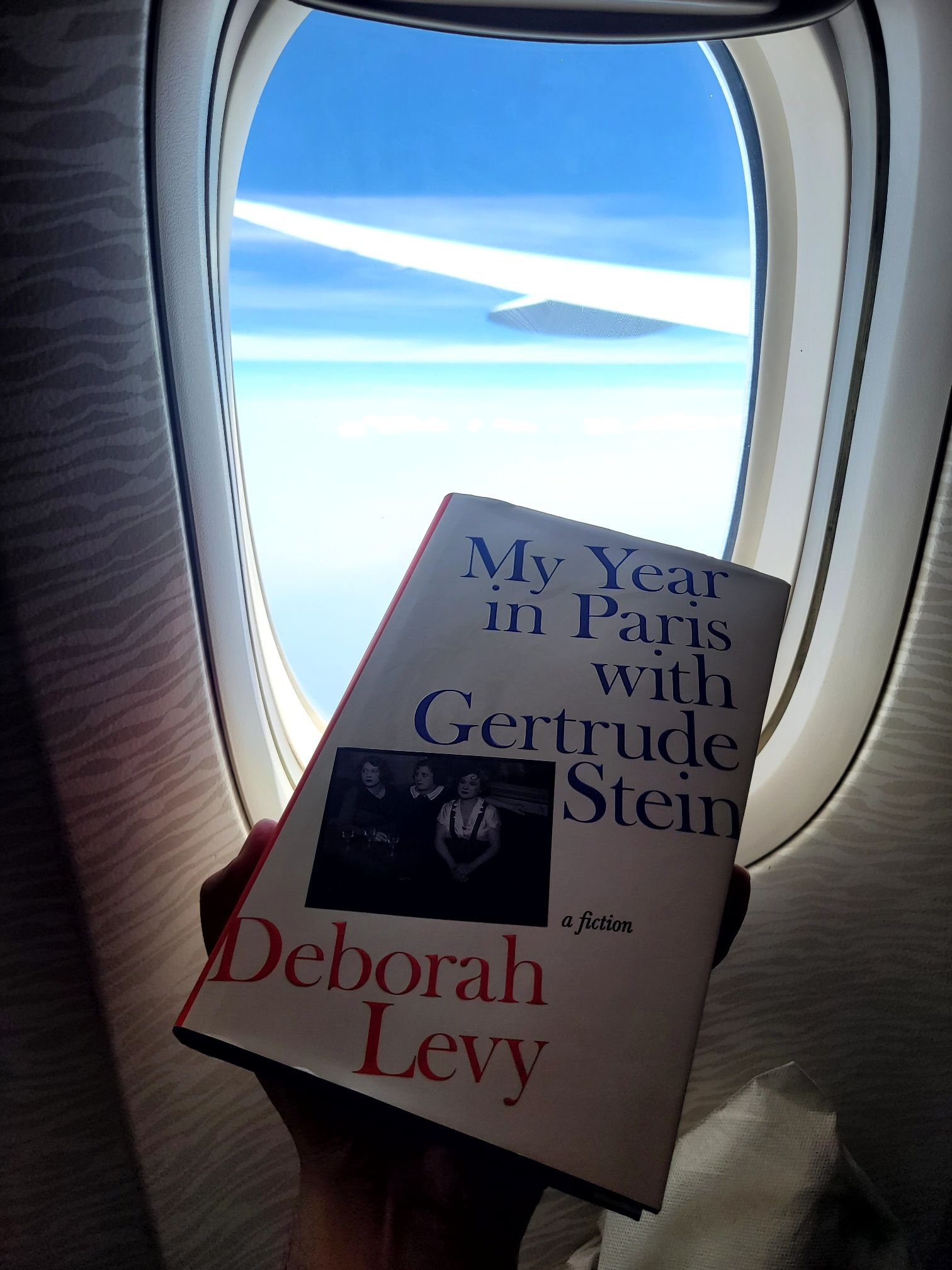
Though the title refers to Gertrude Stein, it’s actually a cat named ‘It’ that goes missing and launches the domino of events. ‘It’ lives with Eva, one of our narrator’s two friends. Eva is an artist working on a graphic novel while staying away from her husband who’s in the US. The other friend, Fanny, works in finance, is polyamorous, overshares her sex life, and is usually yapping on the phone.
And there’s the woman at the heart of this, the elusive Gertrude Stein who finds herself on nearly every page, has lots revealed about her life and friends, is frequently quoted and discussed, yet is never fully grasped by the narrator.
The story kicks off with the disappearance of ‘It’ the cat but this it becomes a literary device which is repurposed to enumerate other it-s that are missing or found – courage, identity, home, servility, confidence, genius etc.
I was travelling when I read this book. So I brought Deborah Levy and by extension, Gertrude Stein, to a city that was not Paris. Like the women, I was also hoping to trade some it-s. What was it I was hoping to lose – lethargy of spirit, my hamster wheel routine, the pain in my neck from office work
What was it I was hoping to find – a train of thought that had nothing to do with office
I have read plenty of Deborah Levy but I had never read her on vacation. She’s fond of writing characters that are displaced from their equilibrium but they adjust to their surroundings. They may not fully get along with those around them but this doesn’t rattle them. Nobody, no matter how brusque or awkward, is dismissed. Friendships persist. Love survives.
Yet it gives the story sheen by repackaging the idea of being lost in a city in the essay that may or may not be written. I read the book in scorching heat, dry and ruthless. On occasions when I had to step out, it was so overbearing that it made breathing harder, even if momentarily.
Deborah Levy has a penchant for touching on subjects that repeat across her works:-
Identity – who are we and how do we make or break ourselves
Displacement – who are we when we are deracinated
Domestic Space – who and what do people give up to be themselves
Meaning of Art – how do we interpret what’s said and what do we leave unsaid.
When superimposed over Gertrude Stein, the book posits how she, a queer, Jewish woman with financial stability, was able to wedge her foot in the door of literature and art, and shape the Modernist movement by patronising (in a good way) the art of Picasso, Cézanne, Matisse etc. As a minor critique, I wasn’t convinced of her genius, especially her “war” against the comma and question mark which came across as a silly quirk cloaked in the language of progressive transgression. But that’s not on Levy.
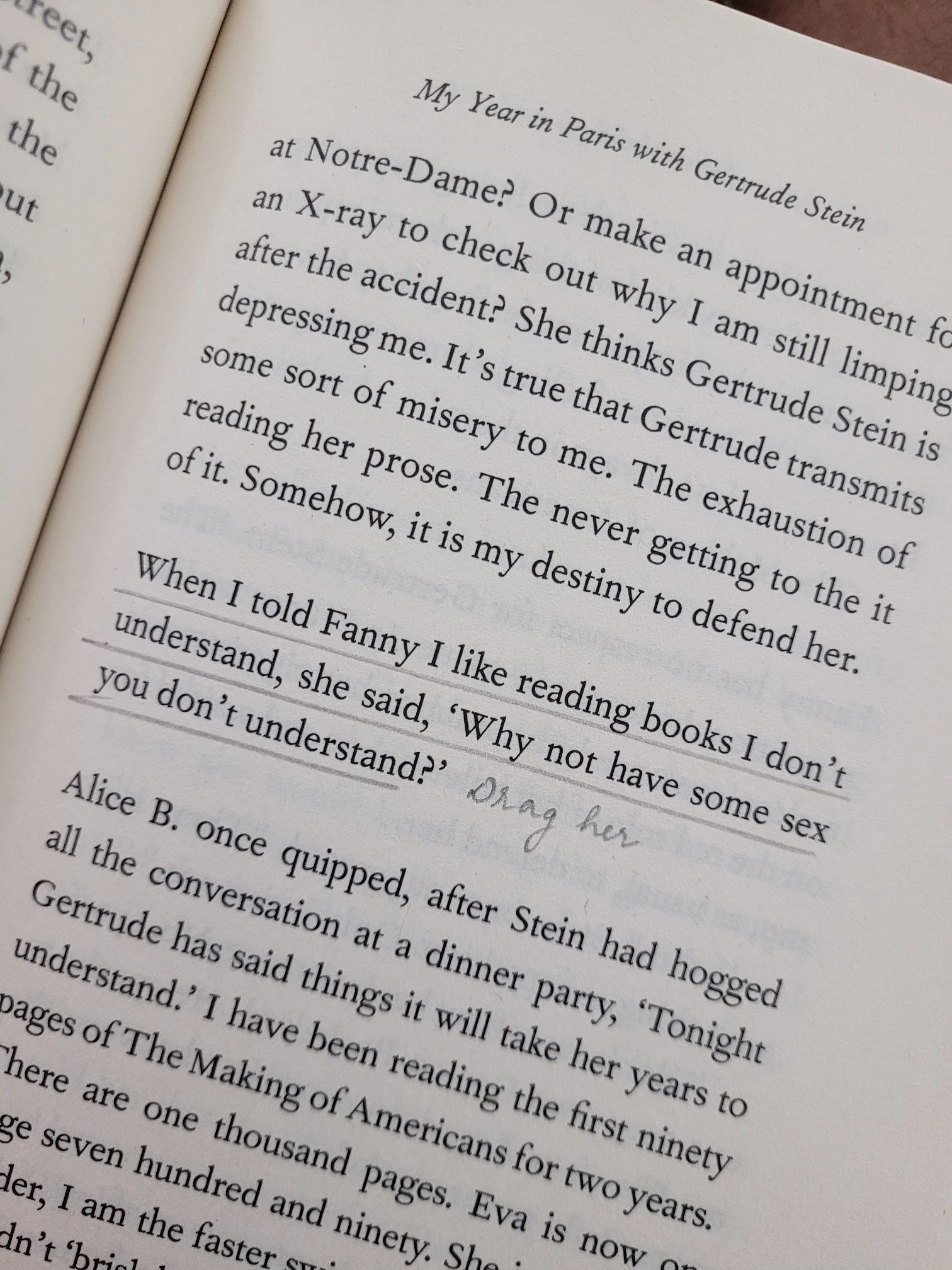
Regarding the narrator’s friends, though it’s Fanny who starts the novel as the radical, more interesting character with her complicated but well juggled love life and sharp rebuttals, including my favourite quote from the book – “When I told Fanny I like reading books I don’t understand, she said, ‘Why not have some sex you don’t understand?’” but by the end it is Eva who overtakes her, including the revelation of where ‘It’ the cat has gone missing and how it had come to her in the first place.
What was it that Eva was doing?
Constructing her life on her terms until something better came along.
It’s this question that Levy ponders too, how do we make or unmake ourselves? What do our desires reflect about us? For Stein, it meant a redefining of herself. Visually, she changed her attire, hairstyle, even footwear to step into her skin. She changed the cadence of her writing. She supplemented her desire of being a genius by already seeing herself as one. She added a performance of “brute superiority”. “It was a better option than the other options available to women of her generation: marriage, taking to her bed, everyday brute inferiority.”
And there’s also the question of being modern and embracing modernity. “Cubism had made the invisible visible. That’s what it takes to be modern. To see it first. And this first revelatory glimpse, she insisted, will always create art that is out of step with its time.” It is to risk being misunderstood. It is to be out of touch with the zeitgeist because you’re inventing one for the future.
During my week in not Paris, I went to a sprawling bookstore where I didn’t find any book by Stein but Levy had a shelf for her work.
What was it I was looking for in the bookstore?
A title that I would associate with this moment in time.
I spotted some books that came with a warning – ‘Ages 21+ only. Please ask counter for assistance’. It was the first time that I had seen an age warning on a book.

Was this a sign of modernism in a bookshop?
What was it that I would be assisted in for those books?
Whose job was it to determine which books required that label?
Were they required to read them cover to cover before they branded them as ‘Ages 21+ only. Please ask counter for assistance’?
Though I had finished reading this book by Day 4, I struggled to start another one from the ones I had purchased from the store. None of my purchases had the label ‘Ages 21+ only. Please ask counter for assistance’. I found myself starting and stopping at least 3 titles after a few pages.
What was it I wanted to read instead?
That’s a question I’ve been asking myself for years. At times, it even hovers in my mind when I’m 20 pages away from finishing whatever I’m reading. I’m already contemplating the needs of my future self.
Coming back to Levy, I did not want to read something similar; I didn’t want something so immersive that I would have had to clean out space in my brain to stop thinking about Levy. What was it that continued to linger on my mind?
It is an answer that hasn’t come to me yet.
The Feynman technique says that if you can’t explain something to a young kid in simple language then you don’t know it well. But when it comes to art and literature, comprehension is often at odds with effect. Levy’s novels have layers and references that escape my attention on first pass. I have to resort to resources to make sense of them, mostly her interviews. Is it my failure, or Levy’s, or a failure of language? What’s an acceptable delay between what you wanted to say versus how it was understood?
Between finishing the book and writing this essay, I’ve talked myself into having enjoyed it more than I did. It has been days but I am still immersed in its atmosphere. I did not spend a year in Paris, it was a week elsewhere but unlike Levy’s narrator, my essay on an interesting figure in literature has come into existence.

